Universe dying as 200,000 galaxies around Earth burn themselves out, scientists say

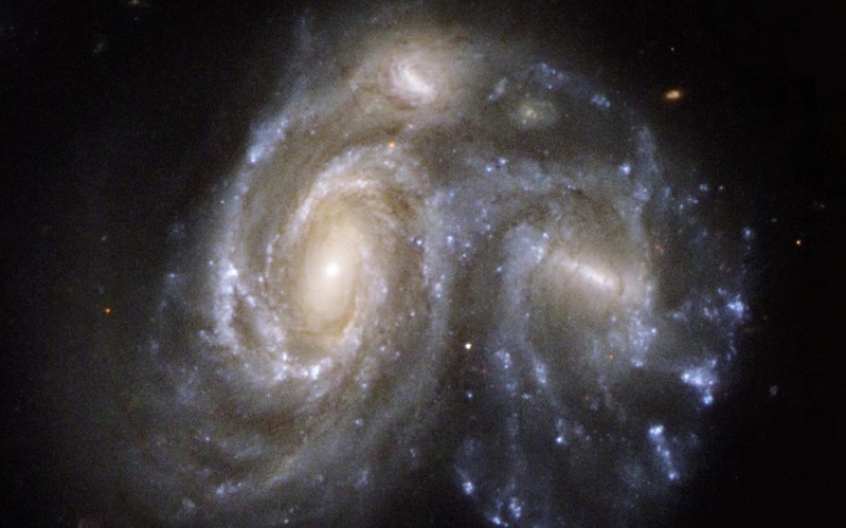
Two spiral galaxies, NGC 6050 and IC 1179, are seen colliding in the Hercules Galaxy Cluster, located in the constellation of Hercules. The two spiral galaxies are linked by their swirling arms. (NASA)

In Revelations 8:1, the Bible warns of this apocalyptic scenario: "There was silence in heaven about the space of half an hour."

Last week, a team of astronomers from around the world warned of a similar apocalyptic situation: the universe as we know it is already dying.

Using several of the world's most powerful telescopes, the international scientists from Galaxy And Mass Assembly (GAMA) were able to determine that the universe is only producing half as much energy as it did two billion years ago.

Simply put, this means that stars in some 200,000 galaxies surrounding the Earth are slowly burning themselves out.

"We used as many space- and ground-based telescopes as we could get our hands on to measure the energy output of over 200,000 galaxies across as broad a wavelength range as possible," GAMA team leader Simon Driver from the University of Western Australia explained in a statement.

Driver further said that based on the new data his team gathered, the universe "will get consistently darker and gloomier" in the future.

Adam Burrows, professor in the astrophysical sciences department at Princeton University, meanwhile, explained that the galaxy gas needed to create stars in the galaxies "is being depleted, and is not being adequately replenished."

Burrows, former chairperson of the National Research Council Board on Physics and Astronomy, nevertheless said that the scenario confirmed by the GAMA should be considered as a "gradual diminution of the brightness of the galaxies," rather than either dying or fading of the universe.

Driver, meanwhile, said that the declining energy production of the universe is not an immediate cause of concern. He explained that there are more immediate challenges for the universe.

"In 5 billion years, the sun will expand and swallow the Earth. In 10 billion years, our galaxy will merge with Andromeda," he said.


related articles
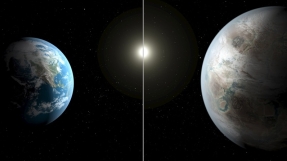
Earth-like planet found circling star similar to sun at same distance as Earth\'s orbit
Earth-like planet found circling star similar to sun at same distance as Earth's orbit

Earth-like planet found circling star similar to sun at same distance as Earth's orbit

NASA estimate: Billions of Earth-like planets in our Milky Way galaxy alone

NASA estimate: Billions of Earth-like planets in our Milky Way galaxy alone

News
Richard Moth appointed as new Archbishop of Westminster

Bishop Richard Moth has been confirmed as the new Archbishop of Westminster, the most senior post in the Catholic Church in England and Wales. 

The mystery of the Wise Men

The carol assures us that “We three kings of Orient are…” and tells us they were “following yonder star”. Can we be sure there were three of them? Were they kings? Where in the Orient were they from? What was the star they followed? In fact, there is a lot that we just do not know. This is the story …

English Heritage deletes debunked claims about pagan origins of Christmas Day

English Heritage has admitted it got it wrong when it shared false claims that the date of Christmas is derived from a pagan Roman festival in honour of a sun god.

Guinness Book of Records recognises 'the world’s longest serving Sunday School teacher'

Pam Knowles started helping out her church Sunday school in 1951 at the age of 13.