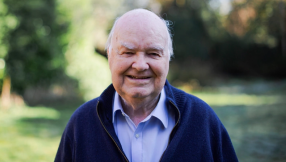
Tim Farron had (probably) just one New Year Resolution for 2018: 'Please God, no more public statements about gay sex'.
Alas, January is full of disappointment. We don't actually know Farron's inmost hopes and dreams, but it's a fair wager he wanted to move on from the haunting news-coverage about his views on sexuality: they led to a highly distracted, disappointing General Election campaign and his resignation as leader of the Liberal Democrats.
Farron, a committed Christian, had become notorious for repeatedly dodging the question 'is gay sex a sin?' last year, saying he didn't want pontificate on theological matters, and stressing his progressive record on LGBTQ rights. He eventually seemed to settle the matter when told the BBC in April: 'I don't believe gay sex is a sin.'
But in June he resigned, saying that 'To be a political leader – especially of a progressive, liberal party in 2017 – and to live as a committed Christian, to hold faithfully to the Bible's teaching, has felt impossible for me.'
In November we met a renewed, confident Farron who seemed intent on shifting the conversation from theological pronouncements to what he really cared about: Liberalism. At the annual Theos lecture he made a fervent, eloquent plea for a society that truly embraces difference rather than trying to flatten it beneath a secular consensus. He condemned the 'tyranny of opinion' and warned that the increasingly narrow and dogmatic tent of left-wing liberalism was in danger of 'eating itself'.
This liberated Liberal Democrat seemed to show signs of moving on, fighting for something bigger than his take on gay sex. He probably wasn't thrilled then to see de ja vu-inducing headlines yesterday proclaiming: Tim Farron says he was wrong to deny gay sex was sinful. A good conversation had taken place with Premier Radio, but how many see past the headline? The BBC's Callum May tweeted a comic prediction of a quite credible future: 'The year is 2067. Tim Farron, aged 97, is still giving interviews about his views on gay sex.'
Some will be cheering for Farron's 'repentance', some will be furious he ever led a 'liberal' party, others will just be sighing that the spectre of sex lingers on. And here we are of course, still talking about it. To misquote Ecclesiastes: 'Be warned, my son...of making Tim Farron think-pieces there is no end, and much study wearies the body.'
But Farron has attracted attention not just for some painful PR on his part: he's been a walking test-case for [particularly conservative] Christians in the public sphere. Believers may look to him and wonder if there's a future for their values in a system that can seem hostile to faith.
Farron is a living question mark to the project of good disagreement, one that's not left many feeling optimistic. Can a conservative Christian answer the question 'is gay sex a sin?' without infuriating one group or another? Farron took several swings and suggested you can't.
But maybe the problem isn't values so much as it is language. The lexis of 'sin' thrust on Farron is not one communally shared in contemporary Britain. The word can conjure up equally unhelpful images of a) a sexy chocolatier or b) a placard-waving religious person who hates another, despises their existence.
Neither captures the historic Christian understanding of 'sin' as a destructive influence common to all humanity, manifested both in individual vice and corporate evils. It isn't about separating the holy from the unholy, it's a description, in the words of Francis Spufford, of The Human Propensity To F**k Things Up.
As Spufford told Theos' Elizabeth Oldfield in a fascinating conversation about faith, love and language for The Sacred Podcast, we need to reject 'win/lose', inherently antagonistic ways of conversing so often present in social media and public life. A 'willed generosity that allows us to notice things we didn't know', a willingness to be wrong, to be seen to be wrong and to even change our minds.
Perhaps embracing Spufford's philosophy offers a ray of hope for a properly 'liberal' discourse, so often clipped by the polarising echo-chambers and linguistic mediums we employ.
Perhaps things will get worse, perhaps they'll get better. Maybe they'll just be different. But talking will be necessary whatever happens, particularly the kind of generosity that gets beyond a headline or a Twitter handle and seeks to truly know one who is 'other'.
After all it seems antithetical to the Christian vision of 'hope' to just check out of a system because it doesn't work the way we want. There will be limits, and 'sin', rightly perceived, will be a thorn for more than just Tim Farron. But a system is just people, and people, as Christianity has dramatically, consistently proclaimed, can always change.
You can follow @JosephHartropp on Twitter