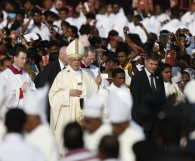
Everyone's always pleased to see Pope Francis.
Since taking office in 2013 he has hardly put a foot wrong, bringing new energy, warmth and humanity to the Catholic Church and acting as a wonderful ambassador for Christ.
However, his visit to the US sees him flying into a storm for which he is hardly responsible, though he will certainly be blamed for it.
Tomorrow he will perform the canonisation of Junipero Serra (1713-1784), a Franciscan friar from Majorca who worked tirelessly to convert the Native American population of California.
Serra's legacy is popular in the area, with streets and schools named after him. His sainthood "cause" has been considered for many years, with historian Herbert Bolton backing him in 1948 and five other historians invited to comment in 1986. Only one miracle has been attributed to him rather than the standard two, but he was beatified – the step before sainthood – by Pope John Paul II in 1988.
The process of ratifying someone's saintly credentials is rigorous, not least because the Church can't afford the embarrassment of finding that a saint wasn't quite as saintly as it thought. However, in Junipero Serra's case, many believe that the Church has made a false step.
Serra was revered during his lifetime not just for his energy and effectiveness – he founded nine of the 21 California missions – but for his spirituality. This sometimes took a form that is strange and rather repugnant not just to Protestants but to most modern Catholics too. He engaged in physical self-punishment, wearing sackcloth spiked with bristles or a coat interwoven with broken pieces of wire under his cassock. During a sermon on repentance in Mexico City he took out a chain and began flogging himself. In other sermons he would strike his chest with a large stone, doing himself lasting harm. He suffered from life-long ailments in his legs, for which he refused to seek treatment.
This sort of indentification with the sufferings of Christ was a standard part of 18th-century Catholic theology, though Serra took it to heroic levels and it was part of his saintly mystique.
It is for his missionary work, however, that Serra is particularly remembered. He left what could have been a very comfortable life in Majorca for a much more arduous one in the New World because he genuinely believed in saving souls. His strategy was to create communities of baptised Indians, who would be trained and educated to fit in with the new economic system brought by Spanish rule and protected from harmful spiritual influences.
In practice this meant that they were not allowed to leave, rations were poor and disease spread rapidly among them. Whatever his motives, Serra is not regarded as a hero by the descendants of those who suffered because of the system he promoted.
It's this collusion with colonialism which has led to an outcry against his canonisation. The Amah Mutsun Tribal Band is one group campaigning against the move. In a letter to Pope Francis, chairman Valentin Lopez wrote: "Serra was the architect of the mission system; he developed the brutal inhumane policies that had not regard for our ancestors." The canonisation, he said, "will confirm the Church's misguided believe that Serra led a saintly life" and "will tell the world that the mission system developed by Serra was holy and sacred". Not so, says Valentin: an estimated 150,000 California Indians died, including thousands of women and children who died from sexually transmitted diseases passed on as a result of rape by Spanish soldiers.
Other Native American groups have made similar points. Matias Belardes, chairman of the Juañeno, Acjachemen Nation, says: "Serra was a man of his time, and that time was a period when the very humanity of our ancestors was called into question by the legal and religious doctrines espoused by the church and state.
"We do not believe that such a man, nor such a time period, should be celebrated."
However, Serra has his defenders, too. He was indeed a man of his time, who believed that the Native Americans were children to be protected and taught. His unashamed paternalism grates appallingly on modern sensibilities and he was certainly part of a system that did terrible damage to indigenous peoples – as Pope Francis himself admitted in July in Bolivia when he asked forgiveness for the "grave sins committed against the native peoples of America in the name of God". But does this mean that he was not, in his way and according to his lights, a saintly man?
A historian's perspective is provided by Robert Senkewicz, professor of history at Santa Clara University and an expert on early California history.
Interviewed by Thomas Rees for the National Catholic Reporter, Senkewicz suggests a more nuanced view. He points out the inevitability of the Spanish impact on Indian life as the colonial enterprise destroyed their traditional agricultural and hunting practices. Serra, like other missionaries, believed that part of their role was to protect them from the worst kinds of exploitation. One way of doing this was to keep them apart from the ranchers and miners who thronged to the region.
Serra himself liked the Indians far more than he liked the military governors he had to work with, and the feeling was often returned.
Senkewicz warns against identifying Serra with the whole missionary enterprise, for good or ill. He says: "While I can understand 21st century people saying that religion should stay out of colonial land grabs and refuse to justify them, we can't simply export that view back to the 18th century. The cold hard fact was that some European power was going to come into California, and the only question for the Church was whether it wanted to try to influence that process from the inside or whether it wanted to remain outside that process and give up any influence at all."
He compares the California situation in the 18th century with the genocide committed in the 1850s as the US expanded westward into Indian land during the Gold Rush: "Whatever their faults, no Spanish or Mexican missionary in California ever came close to uttering the refrain that was heard among 19th-century North Americans, that 'the only good Indian is a dead Indian'. And nothing on the scale of Sand Creek or Wounded Knee ever occurred in connection with the California missions."
Senkewicz's nuanced appraisal, however, is unlikely to satisfy critics of Pope Francis for what he will do tomorrow. Like it or not, for many people Junipero Serra has become a symbol not of heroic virtue but of a whole history of colonial exploitation which is now rightly regarded with horror. For them, disentangling the man himself from the times in which he lived is impossible.
Junipero Serra will be the first Hispanic American saint when he is canonised tomorrow, a fact of which the Vatican is keenly aware. However, whatever the spiritual justification for Serra's canonisation, it's still hard to see it as a good political move. History is too raw, too tangled and too present for the new saint to be universally welcomed.
Follow @RevMarkWoods on Twitter.