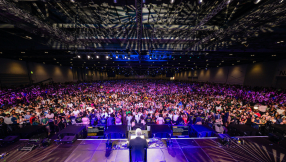
The Church of Scotland General Assembly has approved legislation that will allow ministers to conduct gay weddings in their churches for the first time.
Section 2 of The Recognition of Marriage Services Act (Act I 1977) currently states, "Marriage in the Church of Scotland is solemnised by an ordained minister in a religious ceremony wherein, before God, and in the presence of the minister and at least two competent witnesses, the parties covenant together to take each other as husband and wife as long as they both shall live, and the minister declares the parties to be husband and wife."
After draft legislation was carried 274 votes in favour to 136 against, this will now be changed to remove the words "husband" and "wife".
"Solemnisation of marriage in the Church of Scotland is effected by an ordained minister or deacon in a religious ceremony wherein, before God, and in the presence of the minister or deacon and at least two competent witnesses, the parties covenant together to take each other in marriage as long as they both shall live, and the minister or deacon declares the parties to be married," it will read.
A report to the 2022 General Assembly revealed that 29 presbyteries had given their backing to the legislation.
Twelve were opposed, including two unnamed presbyteries who voted against the changes on the basis that "what is being proposed is contrary to scriptural teaching and would cause further division within the Church of Scotland".
Under the terms of the overture approved on Monday, ministers will have to register to become same-sex wedding celebrants and renew their licence every three years.
New liturgy will now be drawn up for use in same-sex marriage ceremonies, and the Legal Questions Committee will prepare guidance to accompany the changes to Kirk law.
The legislation states that no minister can be compelled to perform a same-sex wedding or be involved in the arrangements against their will.
Ministers wishing to perform a same-sex wedding must also "take account of the peace and unity and pastoral needs of the congregation and of any parish or other grouping of which it is a part".
During the debate, supporters of the overture said that the status quo was causing hurt to LGBT Christians who have been unable to wed in church and that the Church was "making people unwelcome".
Rev Scott Rennie, who is in a same-sex marriage, said he "could not be a minister of this Church" without the love and support of his husband.
Others spoke of the Church of Scotland walking together "in constrained difference".
A number of General Assembly members spoke out against the overture.
Rev Phil Gunn, minister of Rosskeen Parish Church in Alness, in Ross and Cromarty, said that the legislation was "not biblical".
In passing the overture, he said that the Church of Scotland was "stating loud and clear that the Bible, God's word, is no longer our authority, that it's OK for us to pick and choose what we like and ignore the rest, that it is OK for us to rewrite Scripture so that it looks good in the eyes of a society that already thinks we are hypocrites".
He added that while the Church of Scotland was called to love others, "that does not mean we are to conform to the ways of society and the world."
Commissioner Mike Weaver asked whether the Church of Scotland was moving towards a future where its official doctrine will be changed.
Rev Alistair Cook, minister of St Mary's & Old Parish Church, in the Scottish Borders, said that he would continue to describe marriage as a union between a man and a woman during any wedding ceremonies that he conducts.
"This overture, whether we like it or not, approves same-sex marriage. It doesn't matter who is doing it in the Church; it means that the Church is doing it, so it is an approval of same-sex marriage," he said.
Some commissioners raised concerns about the possibility of civil action being brought against ministers who refuse to perform same-sex weddings in their churches.
Rev Ben Thorp, minister of Sandyford Henderson Memorial Church in Glasgow, said, "The court of public opinion is still very strong on this and there is definitely the possibility that churches who choose not to [conduct same-sex weddings] could still be targeted."
Laura Dunlop QC, Procurator to the General Assembly of the Church of Scotland, said that "sufficient" protections were built into the legislation.