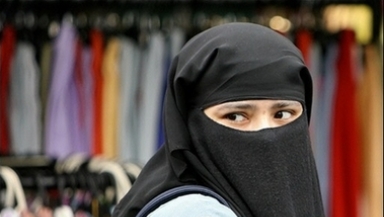
The European Court of Human Rights this week ruled to uphold a ban on women publicly wearing the Muslim veil in France.
In a move criticised by human rights groups as "discriminatory", the Court agreed that the 2011 French law helps support harmonious "living together" and serves to promote interaction between individuals of all faiths and none.
French officials contend that the face plays "a significant role in social interaction" and that open relationships between civilians, promoted by face-to-face interaction, is "an indispensable element of community life".
The European Court's decision has been condemned by Human Rights Watch, however, which has long-held the view that banning certain clothing "breaches the rights to freedom of religion and expression of those who choose to wear the niqab or burqa and is discriminatory".
"Bans of this nature – whether formulated in neutral terms or explicitly targeting the Muslim veil – have a disproportionate impact on Muslim women, and thereby violate the right to not to be discriminated against on the basis of religion and gender," it contends.
Western Europe researcher for HRW, Izza Leghtas, has labelled Tuesday's verdict "disappointing".
"Bans like these undermine the rights of women who choose to wear the veil and do little to protect anyone compelled to do so, just as laws in other countries forcing women to dress in a particular way undermine their rights," she insists in a statement released yesterday.
"Women in France and elsewhere should be free to dress as they please. This includes deciding whether to wear a full-face veil or not, whatever others may think."
Furthermore, in an article for The Telegraph, Shelina Janmohamed, a Muslim woman who herself has chosen not to wear the full veil, warns that the ruling has significant implications for freedom of expression for everyone, regardless of their religious beliefs. "This is a sign that the concrete human rights we have guaranteed by the law can be sacrificed by a concept decided by a state as the state decides it to be," she argues.
"The protection of individual rights is the hallmark of postwar Europe, yet here in this political context we are willing to throw it away, hidden under an irrational fear of the niqab."
In a second article for The Telegraph, however, columnist Allison Pearson applauds the European Court's decision, contending that wearing a veil in public is "hostile and scary" in a Western context. She even suggests that the burqa "is a cause of racism, not a symptom," and a symbol of "grotesque misogyny" that has "no place in a modern democracy".
Despite these reservations, many pressure groups have joined HRW in expressing outrage - insisting that the burqa ban is a sign of growing hostility against Muslims in Europe rather than an attempt to liberate women.
"[It] has nothing to do with gender equality and everything to do with rising racism in Western Europe," says director of human rights lobby group Liberty.
"How do you liberate women by criminalising their clothing?" she asks.
"If you suspect bruises under a burqa, why punish the victim, and if you disapprove of the wearer's choices, how does banishing her from public engagement promote liberal attitudes?"