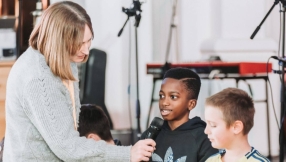
'How can clergy address the legacy of the Troubles?' was the question on the minds of all those attending the Irish Churches Peace Project conference in Northern Ireland yesterday.
The conference, entitled "Go, and do thou likewise" was centred on the theme of the Good Samaritan and how people of faith can show goodwill, empathy, and positivity to others regardless of community affiliation.
It was organised by clergy local to the area in conjunction with the Irish Churches Peace Project (ICPP), and partially funded by the European Union's PEACE III Programme managed by the Special EU Programmes Body.
Catholic priest, Father Paul Byrne, and Anglican minister, the Reverend Andrew Rawding, hosted the conference at Brackaville Parish Church in Coalisland, County Tyrone.
The conference brought together people experienced in the areas of reconciliation and peacemaking.
They included Professor Brandon Hamber, Director of the International Conflict Research Institute, Dr Gladys Ganiel, a lecturer in Conflict Resolution and Reconciliation at the Irish School of Ecumenics in Belfast, and Professor Peter McBride, who has worked for over a decade and a half with the Victims and Survivors Sector in Northern Ireland.
In a joint statement released at the end of the conference, Fr Byrne and Mr Rawding said mental health and wellbeing were a large part of the care that needs to be offered by clergy as they continue to deal with the legacy of the Troubles.
"Extreme violence is no longer a daily occurrence in Coalisland, but high levels of suicide, alcoholism and substance abuse in recent peace process years, suggest that violence has been internalised, and peace has not been processed mentally, emotionally and spiritually for many people," they said.
They pointed to the difficult choices they faced as clergy when trying to deal with these issues, including the temptation to move on without properly addressing pain or trauma.
"Do we ignore the trauma, the unresolved grief, sense of betrayal, mistrust, guilt, shame and the hidden divides? Do we pretend that everything is OK and that everyone has moved, or should move, on?"
On the other hand, the church leaders acknowledged the danger in stirring things up and making the present worse by resurrecting demons from the past.
"Are we creating more 'troubles' if we expose the denial and the silence?" they said.
"As clergy living and ministering in the town, we are faced with the challenge of addressing the impact of these visible and invisible wounds. It is a knife edge of egg shells.
"We are living and working, like many clergy in Northern Ireland, in the valley of the shadow of death. We fear no evil, but we do fear that we could and should be doing more as 'peacemakers', for and among our parishioners."
Other speakers at the conference included Reverend Dr David Clements and Father Stephen Kearney, who spoke on their experiences of the Shankill bombing of 1993 and the reprisal killings at Greysteel.
The Irish Churches Peace Project brings together the Church of Ireland, Roman Catholic, Presbyterian, and Methodist Churches. It is the first time they have held an event in the Coalisland and Dungannon area.
The Churches expressed their desire to see the event act as a springboard to other initiatives supporting clergy, churches and the wider community to work together to address the legacy of the Troubles.
"We want to give grassroots clergy generally a chance to listen to each other, talkabout painful and contentious issues, and acknowledge each others' experiences," the joint conference statement continued.
"We know that some people don't like the 'e word' of ecumenism, the idea that clergy of different denominations should interact together. We prefer words like faith and friendship; taking steps of courageous faith to build friendships which transcend suspicion, insecurity and resentment for the benefit of our community.
"The walk through the 'valley of the shadow of death', leads to 'a table in the presence of our enemies'. The biggest enemy is fear. It prevents us following the example of the Good Samaritan and responding to the command: 'Go, and do thou likewise.' Let's overcome fear by walking together."