High-powered laser beam being developed to defend Earth from approaching asteroids

A meteor fireball is seen over Chelyabinsk, Russia, on Feb. 15, 2013. The resulting blast injured more than 1,600 people. (Wikipedia)

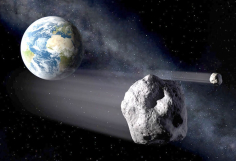
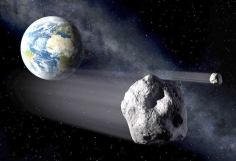
For the past few months, asteroids have been making close approaches to Earth, fuelling fears that these space objects may someday hit our planet and cause countless deaths and massive destruction.

We can, however, ease our fears now because American scientists are already developing a high-powered laser beam to defend Earth from these approaching asteroids.

A team of researchers at the University of California has conducted tests on a weapon called De-Star, which stands for Directed Energy System for Targeting of Asteroids and exploration. The researchers are becoming more and more convinced that this technology may actually work.

"Generally speaking, the technology is available today," said Qicheng Zhang of the University of California, Santa Barbara, one of the authors of the project, as quoted by The Telegraph.

The author nevertheless acknowledged that the team would have to develop a device that will be powerful enough to destroy giant asteroids.

"The main challenge with building a full De-Star is the necessary scale to be effective," Zhang said.

The research team has nevertheless succeeded in testing the De-Star's technique on Earth, by blasting a piece of basalt using laser beams. Basalt is a type of rock from frozen magma that has a similar composition as asteroids.

The team managed to dissipate the asteroid-like rocks in a process known to scientists as sublimation, or turning solid objects into gas. When the rock turned white hot, it began to lose mass.

The team was also able to use the effect to slow and reverse the rotation of a spinning piece of basalt, which means that it can be utilised to direct an asteroid away from Earth.

"That gas causes a plume cloud — mass ejection — which generates an opposite and equal reaction or thrust — and that's what we measure," Travis Brashears, a student who has worked with the group, explained.

Brashears nevertheless admitted that this laser beam technology is still limited at present, because it takes time to dissipate a massive asteroid. In particular, the researchers estimate they could use a 10 kW laser – less powerful than some used by the U.S. military, for example – to deflect a 100-metre wide asteroid over a period of 30 years.

The team is also developing a smaller version of the laser beam device that can fly

Newsletter Stay up to date with Christian Today
related articles
NASA plans Earth defence against possible asteroid strike, forms new office to detect dangerous space objects

NASA plans Earth defence against possible asteroid strike, forms new office to detect dangerous space objects

Asteroid with \'weird orbit\' making return trip near Earth next month, and this time, it may get closer
Asteroid with 'weird orbit' making return trip near Earth next month, and this time, it may get closer

Asteroid with 'weird orbit' making return trip near Earth next month, and this time, it may get closer

Will approaching asteroid come dangerously close to Earth on March 5? Astronomers still unsure


Will approaching asteroid come dangerously close to Earth on March 5? Astronomers still unsure

Huge fireball, 2nd largest in recent history, exploded over the Atlantic on February 6, NASA reveals

Huge fireball, 2nd largest in recent history, exploded over the Atlantic on February 6, NASA reveals

30 minutes from Earth to Mars? It\'s possible using photonic propulsion, says NASA scientist
30 minutes from Earth to Mars? It's possible using photonic propulsion, says NASA scientist

30 minutes from Earth to Mars? It's possible using photonic propulsion, says NASA scientist

News
Government under fire for incentivising more 'lunch hour' abortions

Sir Edward Leigh said it seems as if "abortion providers now writing government abortion policy".

Street preacher case is a 'shocking' attack on freedom of religion and speech

The Christian Institute, which is supporting the pastor, accused the police and Public Prosecution Service of "overstepping the mark".

Christian man prosecuted over ex-gay testimony urges Europe's Christians to take a bold stand for truth

A Christian man in Malta who was repeatedly dragged into court over three years for giving his testimony about leaving the homosexual lifestyle urged his fellow Christians to stand boldly for Jesus Christ amid rising cultural hostility.

Artemis II astronaut who isn't religious cried seeing the cross after Moon mission

NASA astronaut and Artemis II Commander Reid Wiseman said that although he is not a religious man, he “broke down in tears” after returning from the mission and felt such intense emotion that he asked to speak with a Navy chaplain.