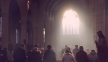
The honey-stoned monastery has been a fixture of the Middle Eastern landscape since the fourth century, a symbol in the land of its birth of Christianity, the faith that shaped the West.
But now, its senior priest is urging all Christians to flee Iraq, because he warns they have no future there any more.
He spoke as government forces prepare to move in to liberate Mosul.
Father Yousif, deputy bishop of the fourth century St Matthews Monastery or Mar Mattei, about 40k east of Mosul, has played a significant role in sheltering the region's multitudes of displaced Christians.
"The future here is bad. Every time a terror group appears under a different name and sets out to persecute Christians."
He will be staying put. "I'm a monk, like a soldier I don't think about himself." But he has urged his family, friends and all other Christians to seek a better future outside Iraq.
Open Doors, the persecution charity, said in a report this week that the Christians of Iraq and Syria faced a cataclysmic crisis. Christian Today discovered via a Freedom Of Information request that disproportionately few Christians from the region were being resettled in Britain.
It is estimated that two million people will flee Mosul when fighting starts, and many will be Christian.
Father Yousif gave an interview to the religious freedom charity World Watch Monitor.
His family used to live in Mosul.
His brother, Ragheed Fahmy Ibrahim, married with two children, who worked as an electrical engineer and served as a deacon at his church, was shot dead on his 37th birthday.
"We got a phone call telling us Ragheed had got into a fight. When I arrived at the hospital, I saw he was shot with three bullets; the first was in his head – entered from one side and out from the other – the second was in his shoulder, and the third in the chest above his heart".
It was meant as an act of intimidation against Christians, Fr Yousif insists, noting his brother was monitored and his killers chose that day specifically. "They knew everything. They chose a Thursday evening as they knew no doctors would be staying at hospitals late before a weekend in Mosul. They made sure he would die."
However bad it gets, as Open Doors found, many Christians still do not want to leave the city and country which has been their home for generations. Fr Yousif's family stayed even after the murder until they learned that other members were on an IS death list.
Fr Yousif said: "My brother Ragheed used to say in the last months before he was killed: 'We have a lot of sins. These sins cannot be washed but by Jesus's blood!' I consider him a hero killed for the name of Jesus."
Persecution is a matter of pride, he added, saying he believed their Muslim persecutors might one day come to know God.
"I forgave them. Believe me I can tell you even Ragheed's wife now forgave those who killed her husband.
"St Paul used to persecute Christians, but later he knew Him and believed."