
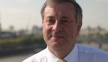
World Council of Churches (WCC) General Secretary, Rev Dr Samuel Kobia, has affirmed the need for "spiritual and practical" ecumenism, as he addressed theological teachers and students in Taipei City.
|PIC1|"The way we live our faith as churches ecumenically informs our common witness, just as our failure to act together and to give a clear witness to the world reflects our failure to be church," Kobia said.
Kobia spent part of his first full day of his 23 to 26 November visit to Taiwan addressing faculty and students of the Taiwan Theological College and Seminary, which dates back to 1872.
"Ecumenism cannot be separated into spiritual or justice-oriented ecumenism, nor into church-based or world-open ecumenism. These different aspects belong together," he said.
"Our Christian faith is deeply spiritual and practical. The Christ whose presence we celebrate in the Eucharist is the same who is among us in the least of our sisters and brothers. The liturgy we celebrate in church extends into the liturgy of our daily lives," he added.
The visit to the seminary was the first stage of a pastoral visit to the Presbyterian Church in Taiwan (PCT) paid by the WCC general secretary and a five-person ecumenical delegation.
The delegation next visited PCT's General Assembly office to engage with members of the secretariat, programme staff and representatives of the Ecumenical and International Relations Committee.
General Secretary Rev Chang Te-Chien noted: "It is our hope and prayer that our unique partnership in the ecumenical family will continue to move forward in the true spirit of koinonia, as we strive to faithfully fulfil our mission calling on local, regional and global levels."
In his remarks, Kobia highlighted that, "The more we engage together as churches, the more we become fully church. And that is what the ecumenical movement is all about. It is that space which brings churches together to witness to the gospel of Jesus Christ and to engage together to overcome any divisions we may have, doctrinally or otherwise."
Among the issues discussed, some PCT members expressed concerns about Taiwan's vulnerability due to the increasing proliferation of nuclear weapons in the region, especially the threat from China and North Korea.
Kobia said, "The World Council of Churches' policy on nuclear proliferation is very clear. The world should be rid of nuclear weapons. WCC calls for all countries with nuclear weapons not simply to commit to not using them, but to destroy them entirely.
"No country should claim nuclear weapons for themselves and at the same time question the right of others to have them. The WCC has made representation to the United Nations and has addressed all countries presently possessing nuclear weapons, including the most recent one, North Korea.
"The Council is working with those countries who have had the capacity to develop nuclear weapons but have chosen not to do so, such as South Africa and Brazil. They are the only countries who have the moral authority to say 'stop.' Although this is an extremely difficult issue in our world today, the WCC will remain relentless in pursuing an end to nuclear weapons."
On the previous evening, Kobia and the members of the WCC delegation were guests at a reception attended by senior leaders of various Protestant denominations in Taiwan.
The ecumenical delegation accompanying the WCC general secretary was composed of Rev Dr Tyrone Pitts (WCC central committee member, general secretary of the Progressive National Baptist Convention, USA); Rev Dr Seong-Won Park (WCC central committee member, from the Presbyterian Church of Korea, South Korea); Rev Fr Gabriel Papanicolaou (ecumenical officer of the Church of Greece); Dr Mathews George Chunakara (WCC Asia secretary); and, as a communications consultant to the delegation, Rev Deborah DeWinter (WCC programme executive for the United States).



-

The dire American political situation: a brief overview for faithful Christians in Britain
-

Conversion therapy ban supporters want prayer to be criminalised - this must not be allowed
-

Why the US election results do not bode well for America
-

Police appeal for witnesses after head smashed off Jesus statue at church war memorial
-

Trump’s midterm defeat and its implications for Christians on both sides of the Atlantic
-

Are we seeing the end of Western civilisation?
Most Popular
related articles
Ecumenical Delegation Visits Rural Chinese Churches
On the second day of a weeklong tour to China, the World Council of Churches (WCC) General Secretary Rev Dr Samuel Kobia characterised Christianity in the country as being "rooted in the soil"...
World Ecumenical Head to Lead Delegation on Taiwan Visit
The World Council of Churches (WCC) General Secretary, Rev Dr Samuel Kobia, will lead an ecumenical delegation on a visit of Taiwan from 23 to 26 November, following an invitation made by the Presbyterian Church of Taiwan (PCT), which is the WCC member church in the country.
Ecumenical Head Discusses Role of Religion in Building China's Future
The World Council of Churches (WCC) General Secretary Rev Dr Samuel Kobia has led a delegation in a meeting with Mr Jia Qinglin, chairperson of the Chinese People's Consultative Conference, on 21 November in Beijing.
Ecumenical Christian Delegation Concludes Historic Visit to China
The World Council of Churches' General Secretary, Rev Dr Samuel Kobia, has concluded his tour of China on 22 November 2006. Leading an ecumenical delegation, Kobia publicly affirmed that "it is in the best interests of the government to actually expand the space for the practice of religion".
News
Is religion making a comeback among young Americans? Study urges caution
New research from Pew Research Center suggests that while there are encouraging signs of religious engagement among younger adults, the evidence of a broader resurgence remains inconclusive.

Calls for inquiry into Queensland assisted suicide system
Despite the rise in deaths, the watering down of safeguards has been proposed.
Justin Welby says government reparations for slavery a ‘moral evil’
Welby was supportive of Project Spire during his time as Archbishop of Canterbury.
South Sudanese churches work for peace as tensions mount
South Sudan is the world's youngest sovereign nation.





