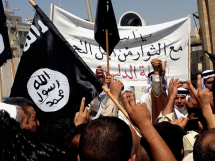
A new government has been formed in Iraq, raising hopes that it might lead to a more effective response to the depredations of the Islamic State (IS) armies which have devastated parts of the country.
The new administration succeeds that of Nouri al-Maliki, widely blamed for concentrating power in the hands of Shia Muslims and sidelining the Sunnis. According to the US, which had previously said that the formation of a new government was a condition of its military aid against IS, the agreement – which sees Sunnis and Kurds brought into the government headed by Prime Minister Haider al-Abadi – represents a "major milestone" and a crucial step towards defeating the terrorist militias.
Well, maybe. However, there are too many things in Mr al-Abadi's in-tray for anyone to feel entirely sanguine that any more major milestones will be reached quickly or easily. The legacy of a functioning administration and civil society, a trained and reasonably effective army and a reasonably free and fair election was spectacularly squandered. The shaky framework left by the retreating coalition forces proved unable to withstand the machinations of external sponsors of terror, generations-long inter-communal hostilities, selfishness, greed and sheer stupidity. It is tempting to hark back nostalgically to the golden days of Saddam Hussein, in the way that post-war Italians remembered that at least Mussolini made the trains run on time. That is not very helpful. What is undeniable is that, given that the eggs were broken, the Iraqi government had the chance to make an omelette. There is no metaphor adequate to the failure which has seen the return of the barbarians to the cradle of civilisation.
Does the West bear some responsibility? Of course. Guilt, war-weariness and political calculations all made for a too-hasty exit. The whirlwind is being duly reaped.
However, there are some grounds for hoping that this time it might be different. One is that instead of trying to impose a military solution on a hostile or indifferent population, Western powers are acting in support of a legitimately-constituted government. That government has still to earn credibility among its people, but what the vast majority of those people want at the moment is security. If their government can give it to them, it will deserve their respect.
Another is that there is universal horror at what Islamic State represents, and a very clear understanding that this sort of religious fundamentalism has to be confronted and defeated. It operates outside any sort of modern democratic discourse; it does not share the same debating space as other religions or philosophies. There are very, very few examples in history of where this sort of dichotomous approach to a people or a faith is justifiable. In general, if you enter into a dialogue with someone, you can find common ground; you might end up finding that you both want pretty much the same thing. In this case, no.
So the words of President Obama, who said: "We are going to systematically degrade their capabilities; we're going to shrink the territory that they control; and, ultimately, we're going to defeat them" command, if we are not wilfully to close our eyes to the bleak necessities of the situation, our painful assent.
However: in this situation, as in every other, Christians want to ask what there is specifically of the Gospel to bring. We should absolutely resist facile panaceas like "They should all turn to Jesus and everything would be fine." We should also be very wary about telling politicians and diplomats how to do their jobs. We are on much safer ground when we deal in principles rather than in practicalities. So here are a few.
1. We, the West, are responsible. No doubt there are many who will want to trace this whole sorry scenario back to the Iraq war. Whatever the merits of this argument, our responsibility is primarily because we share a common humanity and people are suffering. We cannot, as Christians, advocate leaving them to suffer.
2. We should be as generous as we can be, as individuals and as a nation, to the humanitarian relief efforts in Iraq and Syria.
3. We should not flinch, as Christians, from affirming that in principle, the force exercised by Islamic State needs to be countered by force.
4. We should stand against the demonisation of individuals. Islamic State represents an uncompromising ideology that has to be defeated. Those who fight for it are children of God, for whom Christ died.
5. We should be deeply humble about what can be achieved by any Western intervention. Respect for other people's convictions, abilities and gifts ought to be a Christian principle; when this is forgotten, the urge to set the world right has consequences.
6. We should pray.
Rev Mark Woods is a Baptist minister and freelance writer.