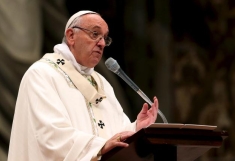
A Norwegian Roman Catholic bishop says it's time for clergy to stop officiating at weddings.
Bishop Bernt Eidsvig of Oslo told the Catholic News Service that he would have to seek permission from the Vatican, but added: "It's clear we must distinguish our own church marriages from others."
Eidsvig was arguing that priests should move to offering Catholic weddings to Catholics, but should no longer act as officers of the state.
He spoke in the context of a decision by the country's Lutheran Church to offer gay marriage services, saying that "we don't understand their decision and hope they'll still reconsider it".
Eidsvig said of his own position: "This is a matter of liturgy, so it doesn't necessarily reflect broader change in our society's moral values. But politicians may now get aggressive toward churches who resist these weddings, so the best option is for us to stop conducting marriages on the state's behalf."
And there's a great deal to be said for this.
One of the problems facing many conservative Christian ministers is that they're afraid that, with shifting morality and increasing acceptance of gay marriage in many places, they'll come under pressure to marry people of the same gender. It's these fears that have driven the 'Pastor Protection Acts' in several US states, which claim to offer protection for ministers against civil actions if they refuse to conduct same-sex marriages. In the UK the government has promised no minister will face consequences for refusing to do so and the default position remains that churches have to opt in to hosting same-sex weddings.
In many countries, a marriage can not only be blessed but actually contracted in a church. Ministers effectively act as registrars on behalf of the state, registering the marriage and returning the relevant books in due course. As such they are potentially vulnerable to pressure if the state ever changes its mind about the degree of religious dissent it is prepared to tolerate. Hence the battles against gay marriage that have been such a feature of conservative Christianity in the US and, to a far lesser extent, in the UK. Even if there is no realistic prospect of ministers being forced to conduct same-sex weddings, churches are implicitly involved – and therefore, some would argue – compromised by the practice, because they serve the same function.
The UK is in a special position because it has a state Church established by law. Anyone has a right to ask to be married in their own parish. One of the consequences of this is that marriage has come to be seen as Christian marriage, even when the couple involved might not be Christians. It is a blessed and honourable estate no matter who contracts it or what they believe, but the problem with this is that it loads a civil institution with all sorts of theological and moral freight that the state is not really well equipped to handle.
So why not go down the route suggested by Bishop Eidsvig and get out of the business altogether? What he seems to be suggesting is the French model, in which all marriages are contracted in a civil ceremony, and those who wish for a religious service can have one if they wish.
There are huge advantages to this. First, it removes the pressure from pastors entirely. No one can launch a civil action against them because it doesn't involve a civil issue. Same-sex and heterosexual weddings would stand on exactly the same footing, with no preferential treatment and no discrimination.
Second, it would allow ministers to choose whom they would marry. Some might choose an open-door policy, regarding it as a way of mediating God's grace at a special time even to people who aren't habitual churchgoers and whose faith might be a bit foggy. But if they wanted to screen out people who just wanted a pretty backdrop for their photographs, they could.
Third, it would allow the Church to stress the Christian character of Christian marriage. It's different because people undertake it in the eyes of God and with the determination, as far as it lies within them, to live together in marriage as part of their discipleship.
Fourth, it draws proper boundaries between Church and state. The Church can argue that marriage is an institution predating the state, with some justification. But if that's so, it also predates Christianity. We can't claim it as specifically Christian except insofar as it reflects the common grace of God to all he has made. Its definition and the legalities around contracting it are a matter for the state, not the Church.
In the same way, the blessing of a wedding in church, where a couple make their vows anew in the sight of God, asking His help to fulfil them and pledging themselves to Him as well as to each other, are a matter entirely for the Church, not the state.
Follow Mark Woods on Twitter: @RevMarkWoods