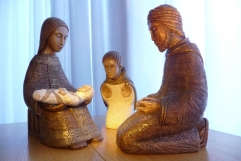
More than 2,000 years ago a baby was born in a stable. We still celebrate his birthday today. But just as we look back and commemorate his birth there were people who, before his birth, looked forward to it.
The birth of Jesus, the Jewish Messiah, was a much foretold event. The Old Testament records more than 300 times prophets predicted details about their Messiah's birth, life and death intended to ensure he'd be recognised when he did arrive. Jesus fulfills every one.
That Jesus was born in Bethlehem, of a virgin and from the line of Abraham, was no accident, but was predicted by prophets centuries before his birth. God provided a road map, foretelling the coming of his son. In 1944 Peter Stoner, a professor of mathematics, did a study to calculate just how likely it would be for Jesus to have fulfilled just eight of the Biblical prophecies. The chances are pretty miniscule – just one in 100,000,000,000,000,000. The probability that Jesus fulfilled 48 of the Old Testament prophecies is one in 10 to the 157th power.
The reality is that Jesus' fulfilling of over 300 prophecies is, mathematically, deeply unlikely to be mere coincidence. It is in the magnificent detail of these prophecies that we can find confidence in the truth of Jesus' significance as both the Jewish Messiah and the Son of God.
As we look forward to celebrating His birth, here are some of the signposts revealed by the prophets pointing towards the birth of Christ.
1. The Messiah will be born in Bethlehem
"But you, O Bethlehem Ephrathah, are only a small village in Judah. Yet a ruler of Israel will come from you, one whose origins are from the distant past" (Micah 5:2).
Micah, an 8th century prophet, described how a leader greater than King David would come out of Bethlehem. This verse is quoted and fulfilled in the accounts of Jesus' birth in Matthew, Luke and John.
"Jesus was born in the town of Bethlehem in Judea, during the reign of King Herod. About that time some wise men from eastern lands arrived in Jerusalem, asking, 'Where is the newborn king of the Jews? We have seen His star as it arose, and we have come to worship Him.' Herod was deeply disturbed by their question, as was all of Jerusalem. He called a meeting of the leading priests and teachers of religious law. 'Where did the prophets say the Messiah would be born?' he asked them. 'In Bethlehem,' they said, 'for this is what the prophet wrote: 'O Bethlehem of Judah, you are not just a lowly village in Judah, for a ruler will come from you who will be the shepherd for my people Israel'" (Matthew 2:1-6).
"And because Joseph was a descendant of King David, he had to go to Bethlehem in Judea, David's ancient home. He traveled there from the village of Nazareth in Galilee. He took with him Mary, his fiancée, who was obviously pregnant by this time. She gave birth to her first child, a son. She wrapped Him snugly in strips of cloth and laid Him in a manger, because there was no room for them in the village inn. When the angels had returned to heaven, the shepherds said to each other, 'Come on, let's go to Bethlehem! Let's see this wonderful thing that has happened, which the Lord has told us about'" (Luke 2:4-5,7,15).
"For the Scriptures clearly state that the Messiah will be born of the royal line of David, in Bethlehem, the village where King David was born" (John 7:42).
2. The Messiah will be born of a Virgin
That Jesus would be born to a virgin is foretold in the book of Isaiah, a prophet who lived in Jerusalem in the 8th century BC. He wrote about the virgin birth of Jesus as a sign to Judah – and predicted that sign would be a child called "God is with us".
"All right then, the Lord Himself will choose the sign. Look! The virgin will conceive a child! She will give birth to a son and will call Him Immanuel – 'God is with us'" (Isaiah 7:14).
In the Gospel of Matthew, an angel visits Joseph, Mary's fiancé, to reassure him of the faithfulness of his wife-to-be. The angel directly quotes this passage in order to explain Mary's pregnancy:
"As he considered this, he fell asleep, and an angel of the Lord appeared to him in a dream. 'Joseph, son of David,' the angel said, 'do not be afraid to go ahead with your marriage to Mary. For the child within her has been conceived by the Holy Spirit. And she will have a son, and you are to name Him Jesus, for He will save His people from their sins.' All of this happened to fulfill the Lord's message through His prophet: 'Look! The virgin will conceive a child! She will give birth to a son, and He will be called Immanuel (meaning, God is with us)'" (Matthew 1:20-23).
3. The Messiah will be born amid sorrow
The violent response of King Herod to the news of the Messiah's birth fulfilled a prophecy of Jeremiah, a 7th century BC prophet, and is explicitly referenced by Matthew's birth narrative.
"A voice is heard in Ramah, mourning and great weeping. Rachel weeping for her children and refusing to be comforted, because her children are no more" (Jeremiah 31:15).
The original context of the prophecy was related to mothers – personified as Rachel - in Israel lamenting the deportation of their sons to Babylon. It might at first seem obscure, or not explicitly about Jesus, but it is repeated in Matthew, where the connection is explained:
"When Herod realised that he had been outwitted by the Magi, he was furious, and he gave orders to kill all the boys in Bethlehem and its vicinity who were two years old and under, in accordance with the time he had learned from the Magi. Then what was said through the prophet Jeremiah was fulfilled" (Matthew 2:16).
4.The Messiah will be from the line of Abraham, Isaac, Jacob and King David
That's a strong heritage. In both the gospel of Matthew and Luke, Jesus' lineage is recorded fulfilling prophecies that the Messiah would come from the line of Abraham (Genesis 12:3), Isaac (Genesis 26:4), Jacob (Genesis 28:14), Judah (Genesis 49:8-12), Jesse (Isaiah 11:1) and King David (Isaiah 9:7). Some scholars have suggested that the genealogy in Matthew is Jesus' legal line, through his earthly father, Joseph, and that Luke's is his bloodline through his mother Mary.
Even this collection of prophecies would be deeply unlikely to be fulfilled in one man, and they are only the ones relating to his birth. Precise details of Jesus Christ's life were foretold in the prophets, including that he himself would be a prophet, that he would be tempted by Satan, rejected by his own people, betrayed by one of his followers, sold for 30 pieces of silver and that his death would be upon a cross.
Jesus' birth in Bethlehem some 2,000 years ago was a crucial part of God's plan for the redemption of his people. His birth, life and death were signposted from the beginning of creation and point forward to our coming redemption.