Today David Cameron announced he will set out a "comprehensive strategy" for taking on ISIS in Syria.
Currently Britain is involved in air strikes against ISIS in Iraq but not in Syria, where ISIS hold vast swathes of land including their major base, Raqqa. Cameron said he believes there is a "compelling case" for extending Britain's military action into Syria and the "case has only grown stronger" since the Paris attacks.
The Prime Minister reminded MPs in a statement to the House of Commons that ISIS do not recognise the border between Iraq and Syria and reaffirmed his "firm conviction is that we need to do more to tackle ISIS in Syria."
The statement will be seen as a strong affirmation of his desire to persuade the House of Commons to pass a resolution supporting action. In 2013 Cameron's attempt to do this was defeated and he is reticent to bring the matter before the house again unless he is sure he will win.
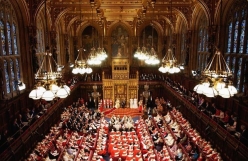
However the necessity to win MPs' approval before Britain goes to war raises problematic questions. Although it would now be considered authoritarian and a breach of power for a Prime Minister not to do so, the convention of asking MPs to decide about going to war is a new and unfortunate one.
There is no constitutional requirement for the government to seek any form of parliamentary approval before war. The Prime Minister has the power to declare war, as an exercise of the Royal Prerogative, without the approval of MPs.
However Cameron's perceived need to receive MPs' approval is a convention that has developed since the turn of the century and did not hamper his predecessors.
The Iron Lady did not, of course, feel the need ask parliament's approval for the Falklands War. Thatcher was advised by the chief of naval staff in a crisis meeting that "Britain could and should send a task force if the islands are invaded." When the Argentine forces landed on the Falklands the next day, approval was immediately given to retake the islands after an emergency meeting of the cabinet. It was not until after the troops had been deployed that the House of Commons backed the decision in a symbolic debate.
When it comes to parliamentary approval for war, Tony Blair and Iraq immediately springs to mind. But even as late as 2001, Blair did not feel obliged to consult parliament over his decision to join the US invasion of Afghanistan, despite significant opposition.
It was only in 2003, over the decision to invade Iraq on the basis of intelligence about Iraq's supposed weapons of mass destruction, that Blair brought the matter to the Commons. On 18 March 2003 a ten hour debate was held at the end of which a motion to authorise the invasion was passed. The British military operation against Iraq began one day later.
Since then a convention has arisen whereby the Prime Minister has to win the approval of MPs before military action.
However this convention which began in the interest of democracy and accountability is concerning and unhelpful. While it may seem appropriate that the decision is made by MPs elected to represent the people, there are a number of reasons why it would be better for Cameron to make the decision himself.
First, despite the appearance of grandeur and importance, most MPs are surprisingly ill-informed. That is not to say they are unintelligent, incapable or lacking in knowledge. It is to say that most have as much access to intelligence reports and diplomatic briefings as you or me. Namely none. As a result their decision will be based on the opinions of colleagues and media reports which, when it comes to going to war, is not a sufficient level of insight.
Second, they are inevitably subject to the public's fickle opinion because they need to be voted back in at the next election. Again this is not to say that public opinion is unimportant. But it is vital to acknowledge that the public are even more ill-informed than most MPs. Not only do they not know the reality of diplomatic insights or intelligence reports but most don't even read a variety of news sources so can hardly be expected to hold a balanced and considered opinion.
In contrast the Prime Minister has the insight and expertise of Cobra to call upon as well as the advice of top military personnel and access to in-depth intelligence and diplomatic reports. Like any politician, he is not immune to the pressures of the next election but he alone is in a position to make an informed and balanced judgement, whether we voted for him or not.
So bearing in mind Cameron has access to all of the above and more, if he really believes that going to war against ISIS in Syria is "the right thing to do," as he insists it is, he should have the courage to exercise his Royal Prerogative. It will no doubt be unpopular. It may well cost him his reputation. But it will be a far more informed and trustworthy decision than the one made by MPs when parliament inevitably votes on the matter in the coming weeks, whatever the outcome.