This morning, we awoke to the extraordinary news that UKIP had made significant gains in the British political system. The once-tiny party, whose candidates mainly resemble Roald Dahl villains, and whose policies are widely lampooned as racist and scaremongering, won scores of seats in councils all over England. Labour MP Chuka Umunna said this morning that the UK was now in "an era of four-party politics" – and to be honest, that's being kind to the Lib-Dems.
But of course, we should have seen it coming.
For the past week, social networking phenomenon Twitter – an imperfect but indicative barometer of the national conversation – has talked of little else. Hashtags have abounded (in particular #whyImvotingUKIP):
- poking fun at the very idea of UKIP
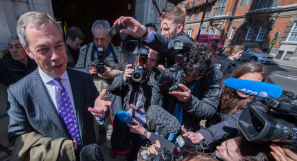
- focusing ire on UKIP's charisma-lite leader Nigel Farage (whose wife is German);
- ...and generally satirising idea that normal, decent people would ever choose to vote for UKIP.
UKIP. UKIP. UKIP. The acronym reinforced, over and over again. On Twitter, on the BBC (who book Nigel Farage about 4000% more often than any other guest, because frankly he is Box Office like no other guest)... even on UKIP's own advertising. I've already mentioned it ten times in this article alone. Yesterday, the country thought that the hashtag, launched by the party's own comms team, had spectacularly backfired. Today, it feels like the backfire itself, backfired. Those who sought to criticise performed their own unintentional masterstroke of brand reinforcement.
Despite the liberal bias on Twitter, its users come from a broad range of perspectives; a little like a gone-upmarket pub that still has a gathering of bewildered locals in the corner. Not everyone on Twitter uses it to make witty puns; some simply read, digest, allow their opinions to be subtly affected. For those who do actually fear the UK is going to the dogs / being overrun / becoming a slave to some imagined Brussels Pharoah, the jokes were actually a reminder that they could choose to vote for a far-right party that might address those concerns. And they didn't make jokes; they turned out and voted.
Twitter and its conversations are not bad things in themselves. The simple hashtag contains the power to mobilise genuine political activism (like in Egypt and Syria), or to unite the world around something which might otherwise be ignored (such as the #bringbackourgirls campaign for the kidnapped Nigerian schoolgirls). The problem comes when we mistake online interaction with offline action, and allow one to fully replace the other.
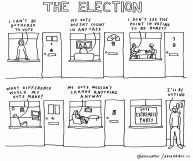
For #whyImvotingUKIP to trend so consistently means that hundreds of thousands of people used the tag over the last few days. Did those people all turn out to vote; to turn their sarcastic dissent into real-world activism? The idea that they might have not done has been termed 'slacktivism'; the idea that by retweeting something important or making a satirical joke at a Bad Thing's expense is enough to play your part in bringing positive change. And the truth is that it isn't – we still need physical rescuers to #bringbackourgirls, we still need citizens of oppressed states to physically mobilise, and we still need physical voters to prove that #whyImvotingUKIP was really just a joke...
This shows up among people of faith too with the dreaded #praying hashtag. I know that I have, on countless occasions, indicated that I would respond to someone's need or prayer request, using that label. I don't suppose I'm alone. The thing about prayer though, is that it works best when we actually do it. Using the hashtag and leaving it there is – like retweeting a worthy cause as a substitute for actually engaging with it – essentially redundant.
If today's news teaches us anything then, it's that not everyone is a slacktivist. The people who want the UK out of Europe, even if it means getting behind Nigel Farage, don't just tweet about it. This is a real world, with real problems, and the people who change it for better or worse are those who move from conversation to action. While shocking to many, the massive and unexpected gains won by UKIP provides us all with a huge dose of reality. I hope we slacktivists will learn from it.
Martin Saunders is the creative director of youth organisation Youthscape, and a writer and broadcaster. Follow him on Twitter @martinsaunders