Traumatised and repeatedly relocated, Syrian refugees face further hardships as the pressure grows on host communities in Jordan, Lebanon and Iraq.
The United Nations has confirmed that the number of people leaving Syria has reached 3 million people, describing the situation as the "biggest humanitarian emergency of our era".
Of the 3 million total, Lebanon has received the largest number, with 1.14 million seeking refuge in a country with a native population of less than 5 million people. Jordan has taken 608,000 refugees and Turkey 815,000. The UK has taken 50. An additional 6.5 million Syrians have been internally displaced.
Syria's ethnic Kurds have tended to flee to Kurdistan in northern Iraq, where the humanitarian situation is becoming increasingly difficult. There are more than 217,000 Syrian refugees registered in northern Iraq, added to the large number of displaced Iraqis also fleeing to the semi-autonomous Kurdish region.
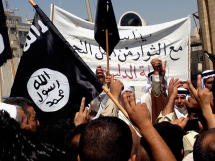
Despite fears of the spread of the Islamic State in Iraq, Syrians are still fleeing there. Many will have to move again before they are safe.
Leaving Syria is itself a last resort – refugees will have moved several times within the country before finally leaving. And the journey out is far from secure.
Safiyya, a 23-year-old Syrian woman, walked for six hours through the night, from Daraa to Jordan with a group of around 90 others leaving Syria.
"I was afraid on the way, coming here, because there was some shooting at us," she said. "We walked all the way and I was pulling myself.
"While we were [in Syria] we were not living in our houses but in shelters underneath. We heard stories that people unknown to us would come into the village and massacre, beheading, slaughtering people in their houses.
"A cousin and a neighbour, I saw them, I witnessed them slaughtered. It's normal. It's becoming normal to us."
Safiyya was training to be a teacher in Syria. She is now working as a kindergarten supervisor for Syrian refugee children run by a local charity in partnership with Tearfund.
"There are worrying signs too that the journey out of Syria is becoming tougher, with many people forced to pray bribes to armed checkpoints proliferating along the borders. Refugees crossing the desert into eastern Jordan are being forced to pay smugglers hefty sums (US$100/£60 a head or more) to take them to safety," the UN statement said.
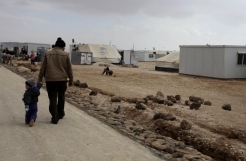
It is easy to picture thousands of refugees in UN camps, but 85 per cent of Syrian refugees are living outside of formal camps. While local communities in host countries have been welcoming, it places a strain on local resources, and scarcity has inflated commodity prices.
"When the Syrian refugee crisis began in March 2011 there was a relatively modest response on the part of the international community, and those dealing with if from day one were the [host] communities," said Lucretia Puentes, Syrian emergency programme manager for Christian Aid.
"The generosity kept being reiterated by the refugees. But now we are seeing an increase in tensions as the situation is more and more protracted, and people see insecurity in the future. They're fearful of the risks facing them and their families."
As well as strains between host communities and refugees, families in exile face other problems, including an increase in domestic violence.
"When families are displaced and settling in close proximity to one another, the breadwinner is deprived of access to a job and it all contributes to tensions within the household," said Puentes, adding that although they know domestic violence happens in this context, it often goes unreported.
Christian Aid is aware of the need to support host communities, ensuring that foreign aid doesn't only go to refugees and further inflame tensions.
António Guterres, the UN high commissioner for refugees said the crisis in Syria "has become the biggest humanitarian emergency of our era, yet the world is failing to meet the needs of refugees and the countries hosting them."
Both Tearfund and Christian Aid have ongoing appeals for the crises in Syria and Iraq.