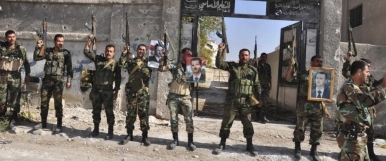
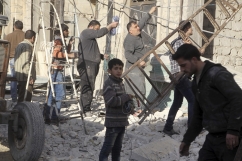
Fighting appeared largely to stop across most areas of western and northern Syria on Saturday after a cessation of hostilities came into effect, which the United Nations called the best hope for peace since the civil war began five years ago.
Under the US-Russian accord accepted by President Bashar al-Assad's government and many of his enemies, fighting should cease so aid can reach civilians and talks can open to end a war that has killed more than 250,000 people and made 11 million homeless.
The truce is the culmination of new diplomatic efforts that reflect a battlefield dramatically changed since Russia joined the war in September with air strikes to prop up Assad. Moscow's intervention effectively destroyed the hope his enemies have maintained for five years -- encouraged by Arab and Western states -- to topple him by force.
The fragile agreement is the first of its kind to be attempted in four years and, if it holds, would be the most successful truce of the war so far.
But there are many weak spots in the agreement, which has not been directly signed by the Syrian warring parties and is less binding than a formal ceasefire. Importantly, it does not cover powerful jihadist groups such as Islamic State and the Nusra Front, al Qaeda's branch in Syria.
"Let's pray that this works because frankly this is the best opportunity we can imagine the Syrian people has had for the last five years in order to see something better and hopefully something related to peace," UN Syria envoy Staffan de Mistura said at a midnight news conference in Geneva.
He said he expected occasional breaches of the agreement but called on the parties to show restraint and curb escalation.
Several insurgents in the western and northern part of the country said early on Saturday that it was mainly quiet so far.
In early reports of violence, a Syrian rebel group in the northwest said three of its fighters had been killed while repelling an attack from government ground forces a few hours after the plan came into effect. Its spokesman called it a breach of the agreement; the Syrian military could not be reached immediately for comment.
Syria's state media said at least two people were killed and several wounded when a car bomb exploded at the entrance of Salamiya, a town east of Hama city and a frontline between government forces and Islamic State group. The Syrian Observatory for Human Rights which monitors the conflict said it was carried out by Islamic State.
Damascus and Moscow say they will respect the agreement but continue to fight the Nusra Front and Islamic State. Other rebels seen as moderates by the West say they fear this will be used to justify attacks on them.
Russia's defence ministry said it had suspended air strikes in a "green zone" -- defined as those parts of Syria held by groups that have accepted the cessation.
Nusra Front, one of Syria's most powerful Islamist rebel groups, often operates close to other groups, making it potentially difficult to prove whether strikes have targeted it. On Friday, Nusra urged insurgents to intensify their attacks on Assad and his allies.
"THERE IS CALM"
A rebel fighter said government forces briefly fired artillery at a village in Aleppo province, which he said was under the control of the Levant Front, a group under the umbrella of the Free Syrian Army which has backed the truce.
Nevertheless he said the frontline was quieter than before the agreement took effect.
"There is calm. Yesterday at this time there were fierce battles. It is certainly strange, but the people are almost certain that the regime will breach the truce on the grounds of hitting Nusra. There is the sound of helicopters from the early morning," he told Reuters earlier on Saturday.
Fighting raged across much of western Syria right up until the cessation came into effect but there was calm in many parts of the country shortly after midnight, the Observatory said.
"In Damascus and its countryside ... for the first time in years, calm prevails," Observatory director Rami Abdulrahman said. "In Latakia, calm, and at the Hmeimim air base there is no plane activity," he said, referring to the Latakia base where Russia's warplanes operate.
Some gunfire had been heard shortly after midnight in the northern city of Aleppo, and there were some blasts heard in northern Homs province, but it was not clear what had caused them, Abdulrahman said.
UN DEMAND
After years in which any action by the United Nations Security Council was blocked by Moscow, Russia's intervention has opened a path for multilateral diplomacy while undermining the long-standing Western demand that Assad leave power.
The Security Council unanimously demanded late on Friday that all parties to the conflict comply with terms of the plan. De Mistura said he intends to restart peace talks on March 7, provided the halt in fighting largely holds.
UN-backed peace talks, the first in two years and the first to include delegations from Damascus and the rebels, collapsed earlier this month before they began, with the rebels saying they could not negotiate while they were being bombed.
The government, backed by Russian air strikes, has dramatically advanced in recent weeks, moving close to encircling Aleppo, Syria's biggest city before the war, and threatening to seal the Turkish border that has served as the main lifeline for rebel-held areas.
In the final day before the truce on Friday, at least 40 government soldiers and allied fighters and 18 insurgents were killed in battles and air strikes in Latakia province, the Observatory reported.
Six people were killed in an air raid in western Aleppo province and dozens of air raids hit the besieged suburb of Daraya in the hours before the halt. Rescue workers said at least five people were killed in Douma, northeast of the capital.
The United States said it was time for Russia to show it was serious about halting fighting by honouring a commitment not to strike Syrian groups that are part of the moderate opposition.
The United Nations hopes the truce will allow access for desperately needed humanitarian aid, particularly to areas besieged by the fighting.
"It is time for the warring parties to end this horrendous conflict and for the world powers who can influence the situation to act decisively," Red Cross President Peter Maurer said in a statement. "Humanitarian deliveries must not depend on political negotiations."
The US-backed Kurdish YPG militia, which is battling Islamic State in the northeast and Turkish-backed rebel groups in the northwest, said it would abide by the plan, but reserves the right to respond if attacked. Turkey, despite being a NATO ally of Washington, opposes the YPG and also says it will respond if attacked.
Fighting between the YPG and Islamic State continued in Raqqa province, the Observatory said.