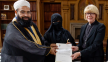
Donald Trump's second inauguration has unsurprisingly led to a hive of activity and controversy. We've had controversial pardons, controversial arm gestures, and we've even had a controversial sermon delivered by the Episcopal Bishop, Mariann Budde.
During her sermon, Budde specifically addressed the new president, and asked him to "have mercy" on immigrants and on the LGBT community who were "scared" of his new administration. The sermon was criticised by right-wingers for being unduly political, but praised by left-wingers for bravery.
On the other side of the political coin, Calvin Robinson had his license to operate as a priest in the Anglican Catholic Church revoked after he copied Elon Musk's supposed "Nazi salute" gesture while giving a speech to pro-lifers.
A duty to speak the truth
Is it wise or, indeed, biblical for church leaders to take political stances? It's possible to find examples from the Old Testament, especially of prophets, giving the word of God directly to kings and those in authority.
By contrast, Jesus himself showed remarkably little interest in politics, ("My kingdom is not of this world") but was very interested in bringing healing and salvation to the everyman.
So which model should the modern church man or woman follow?
Was Bishop Budde acting as an Old Testament prophet when she asked President Trump to embody the Christian virtue of mercy? Was Calvin Robinson? Is John MacArthur acting as a prophet when he writes open letters castigating California Governor Gavin Newsom?
Perhaps.
A divided church
The difference between then and now is that, for better or worse, we are living in democratic societies. In the Old Testament, arguably the only person a prophet needed to convince to bring about social or religious change was the king.
Nowadays the 'king' is a kind of avatar for the will of up to half the population. Attacking 'him' is attacking 'them'. To make matters worse, in our increasingly divided societies, the 'other guy' is the embodiment of evil (and so are their supporters).
What this effectively means is that should a priest get party political they will immediately alienate half of their congregation.
The church is meant to be "one body" in Christ. It should not be the case that we have Democrat or Republican churches, or Labour or Tory churches.
There is no doubt that church leaders must feel under pressure at times to comment on pressing political issues. In some senses they are in a no-win situation. Comment and you're interfering in political matters 'not of your concern'; don't comment and you're not being 'relevant'.
Perhaps the wisest course is to stick to preaching the message of the Gospel and let the congregation draw their own conclusions. There is no harm in conceding that big political issues exist for Christians to grapple with, but trying to discern and then preach God's views on Brexit, the tax rate and international affairs might be an overly ambitious endeavour.