My gerbil died under a Tory government.
Fact.
I can't honestly say, though, that I had thought of connecting the two until I started to get to grips with the arguments around the Scottish referendum.
I should say that I am a British Englishman, living in England and with – as far as I know – not a drop of Scottish blood in me, let alone an address north of the border. So I won't have a vote on Thursday.
What I do have is a passionate desire to see the preservation of the Union, which has done so much for the nations of these islands and for the wider world. I have a deep fear of the consequences both for Scotland and for the remainer of the UK if there is a vote for independence. I see a Britain whose influence on the world – which, unfashionably, I see as a positive and healthy one – will be diminished, and a Scotland which will struggle for years before it sees a realisation of the promises made to it by the Yes campaign – if it ever does.
On Monday evening I took part in the pro-Union demonstration in Trafalgar Square. There were thousands of us – again, mainly English and very few with a vote, but all with a sense of the magnitude of the loss we would all suffer – Scots, Welsh, English and Northern Irish – with the advent of a disunited kingdom.
Here we return to the gerbil. One of the great fallacies of political debate is the "post hoc, ergo propter hoc" argument: after, therefore because of. It is the finding of connections where none exist. It is the making of meaning out of the meaningless.
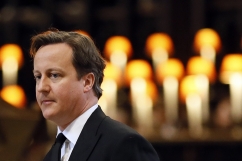
There are all sorts of reasons why people are attracted to the Yes campaign. One of them is that, in common with probably the majority of people in the still-United Kingdom, they feel disenchanted with and disenfranchised by politicians as a class. Of course this sense of distance has been amplified by the fact that Labour – traditionally strong in Scotland – is out of power and we have a Conservative prime minister who, in spite of his surname, is as English as you can get. We're also just coming out of a savage recession. The NHS is in crisis. There are wars and rumours of wars.
Post hoc, ergo propter hoc. If only Scotland had been independent, my gerbil would be alive today.
Of course that isn't the only reason so many people are going to vote Yes. Some are genuinely convinced by the economic arguments. For some, the heart rules the head unashamedly and they would vote for an independent Scotland even if it meant a return to living in Pictish roundhouses. For most, though, there is just an honourable desire that tomorrow should be better than today – and a fastening of the responsibility for their present trials on someone else, or something else.
Frankly, I don't buy that. I honour the desire for a better world; I honour national pride, the desire for a say in what matters, the desire to be heard. But the idea that independence can deliver all that in a way that Union fundamentally can't? It's a dead gerbil.
Here, I believe, it becomes possible to say something specifically Christian about all this. I'm troubled by the increasing fragmentation of the geo-political landscape. Some of it is driven by the far right; ironically, in the referendum campaign it is the left that claims to have been granted a vision of sunlit socialist uplands. However, the impulse towards nationalism, competition, isolation and rejectionism runs counter not only to everything we've learned since the Second World War about creating just and prosperous societies, but is theologically questionable at a quite fundamental level. The Gospel, after all, invites us to ask not just "What's best for me?" but "What's best for us?" – and to expand that "us", as Jesus does in the parable of the Good Samaritan, to include the stranger as well as the clan. I haven't heard anyone seriously argue that Scottish independence would be better for England, Wales and Northern Ireland – only that it would be better for Scotland. Is that really the sort of argument Christians should be comfortable with?
Heart, head and Bible – I'm pro-Union. I hope and pray that Scotland votes No on Thursday.
Mark Woods is a Baptist minister and freelance writer.