As a long-term religion correspondent, readers have from time-to-time queried why it is that, presented with a story about faith, all I seem to write about is gay sex. So I hope that some might be pleasantly surprised to discover that today, presented with a story with quite a lot of gay sex in it, I've decided instead to write about faith.
Being quite far back in the long queue of journalists seeking to interview the Rev Richard Coles about his new autobiography, I felt it necessary to apologise. Surely he would be bored at having to repeat his life story for the "nth" time. "Not at all," he replied. "I love talking about myself."
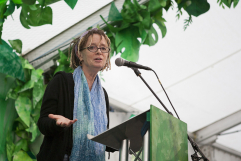
This self-obsession is forgivable because almost everything he says makes us, the audience, laugh. It also explains how he has had the courage to make quite such a public confession. I was speaking to him in a gallery at BAFTA, where earlier, Chine Mbubaegbu of the Evangelical Alliance had interviewed him at the annual Church and Media Network Conference. Coles, the non-singing member of the Communards who now presents BBC Radio 4's Saturday Live programme, is openly gay but celibate. He lives with his partner, Rev David Coles, and he is parish priest of St Mary's Finedon in the Peterborough diocese.
Coles is extraordinary, impressive, humbling. His lunch with actor Tom Hollander inspired the hit TV series Rev. Before the Communards, he was in Bronski Beat. Interviewing Coles now as a vicar feels surreal, especially knowing as most of the country must do, thanks to those other interviews and the biography itself, of the promiscuous gay sex debauchery that did not so much as lead to his conversion to Christianity, as follow on after it. It occurred to me that readers of Christian Today, being quite capable on their own account of Googling the words "Coles", "dogging" and "dog collar" (say a prayer first), might like to read something oriented explicitly towards faith.
One of the most powerful passages in the book, read out by Chine at the conference, is his white-light Damascene moment of coming to faith. I ask him to tell the story again. "Conversion is interesting. It is a process but also for me it was a decisive moment," he says. "I was a total mess and my life was a sort of wreck at the time." The writer Sara Maitland was helping him. "She saw a place I might go which was St Alban's Holborn, perhaps the most flamboyant of the flamboyant Anglo-Catholic churches in London. She said go along to something called Solemn High Mass.
"I had no idea what that meant. So I went along at 11 o'clock on a Sunday morning, I sat at the back and mercifully nobody tried to befriend me or ask me to do something. And they handed me a book and I had no idea what was going on. And then this wonderful music suddenly emerged, the organ began to play and the choir sang and this great rustling rattling procession came past of these people vested wonderfully, and there was scented smoke and light streaming in.
"And then three men stood at the altar and one in the middle picked up a white disc and lifted it up, and the smoke rose and and the sunlight struck it, and someone rang a bell. And this bell - it was almost like something within me broke. It really was like I felt that my chest was constricted by chains and they broke and all of a sudden I could breathe and all of a sudden I could see and all of a sudden - well I wept and wept and wept and wept and became this kind of sobbing mess in a grotesquely out of place scarlet puffer jacket in a back pew at St Alban's Holborn. And then years later, I remember coming across Wesley's hymn, And Can It Be, and realised that what I'd experienced, in the very unlikely setting of St Alban's Holborn, was a classic Protestant conversion."
Just imagine for a moment, where he would be had Coles been in one of the countries worldwide that has the death sentence for homosexuals. Imagine his great gift, that of communicating such moments of conversion in transfiguring ways, being lost forever to the terrifying righteousness of persecution.
I still want to know, though, how a literate and enquiring man such as Coles can begin to justify the very concept of faith. Is it not ludicrous to believe at all in the Christian faith in a secularised world where everyone knows so much better? How can he justify this?
"I don't think you need to justify faith, faith is its own justification," he says. "And even though you might think we live in a world where the possibilities of faith are very much eroded by the growth of secularism, by the hostility of mainstream culture to religious ideas and the things of religion, it does surprisingly prove to be very enduring and - the grace of God comes and surprises us doesn't it - continues to do it in all sorts of interesting ways. It would be nonsensical to pretend we didn't live in a time of enormous challenges for faith and certainly for religion today, but there are enormous opportunities for that too so I think it is a good time to be doing it."
He came from a background that was barely Christian, although even that was more than many young people get today.
"I was born into the Church of England but in the most nominal way possible you can imagine, so it's Christmas and Easter. And then like a great many clergy in the Church of England I actually got nobbled by being a chorister. So I was a boy treble from the age of eight, and found without realising it that I was being inculcated in the tradition and culture of the Church of England through singing, really. I didn't believe any of it at all, but I did take away something that smelt good and felt right, that sounded harmonious."
As a child, although he sang in chapel at his school, belief was not on the cards. "We live in a materialist world and clearly any sort of claim on our credulity of the supernatural was ridiculous. I didn't believe in it any more than I would believe in a fairy story or a myth, not even a myth. I thought it was plainly nonsense. I couldn't understand how anyone could believe that guff when clearly, every sense we had told us that the world was a material phenomenon."
His honesty about and justification for his sex life is surprisingly frank. "I did have quite a lot of debauchery. The customary thing in a story of conversion would be that the conversion happens and the debaucheries cease. But it wasn't that way with me actually. In some ways the debaucheries increased. I think I was quite a damaged person. I grew up gay in the 1970s when that was quite tough. I think I was quite damaged by that experience. I think I had become persuaded of my own unloveliness. Funnily enough, having debauched sex with strangers which was very commonplace for gay men actually and still is, rather healed me of that. And continued, in fact intensified after I became a Christian. But then ceased because I think Jesus Christ calls us to lives of faithfulness stability and commitment and clearly that's not that sort of life. But I don't regret it and I can't repudiate it because actually I experienced it as a blessing. Not entirely, but it was that."
He now finds being celibate quite easy. "Of course it has its challenges and sacrifices. Two things happened. We arrived at a stage in our lives when our sex lives just dropped off anyway as they tend to do. The bourgeois fate, as they say. But also it coincided with the church deciding that it wanted a measure of clarity about what it considered kosher and not kosher. So we live in good standing with the teaching of the Church, but I wouldn't wish that to imply that I saw that as a good and noble thing, because I don't, but it is currently where we are." So here, he is admitting to following Church teaching because it is what the Church teaches, even though he opposes it. "I think the church should bless and recognise the blessing and grace in same-sex relationships as it does in heterosexual relationships."
In explaining his day-to-day faith, he comes up with this analogy: "As a clergyman I just keep thinking of the verses of hymns, I feel His presence every passing hour. It's an interesting one isn't it? I think of it as if Jesus is like someone who has just left the room, they are not there but the temperature is different and there's a sort of current in the air and a mood in the room that somebody extraordinary and charismatic has just passed this way. I get that. Then I encounter Jesus Christ in my life of prayer. The more disciplined I am about that, the more richly I experience that. And more and more in Scripture, the record of Jesus Christ, his life, the effect he had on other people, what endures of his teaching, the miracle of Him, the grace of Him, in Scripture."
He is sad about the young people who are leaving, but hopeful some will return. Sometimes, leaving is the right thing to do. "I completely understand why people would find the Church intolerable. I'm not the least bit surprised when people seek to leave it, though I miss them and I wish they'd stay. But I sometimes think you leave to come back, and that's certainly true in my case. I needed to go, there are so many things in my life where I've needed to go away to realise that I wanted to come back. You come back to the beginning and you discover it anew." We say goodbye and I go off, humming quietly a song of my heart, of my youth. "Don't leave me this way.... set me free, set me free, free, free, free........"