Pope Francis has called on the Philippines government to tackle corruption and hear the cries of the poor suffering from "scandalous social inequalities" in Asia's most Catholic country.
The Pope went to the Malacanang presidential palace for an official welcoming ceremony led by President Benigno Aquino as tens of thousands of ecstatic Filipinos lined the streets.
Francis, a champion of the poor, pulled no punches in calling for a more just and caring society in the Philippines, which is about 80 percent Catholic.
"It is now, more than ever, necessary that political leaders be outstanding for honesty, integrity and commitment to the common good," he said.
After meeting Aquino, Francis later celebrated a Mass in Manila's colonial-style cathedral. He made a surprise detour from his schedule after the Mass when he went across the street for a brief visit a Church-run home that cares for former street children, many of whom were once child prostitutes and members of youth gangs.
Aquino, the only son of democracy champion and former president Corazon Aquino, took office in 2010 on the promise of transparency, good governance and battling corruption to lift the Philippines from poverty.
But he has struggled to shed the country's image as one of the most corrupt in Asia as he continues to defend his allies, while at the same time chasing down politicians, bureaucrats and generals associated with the past administration.
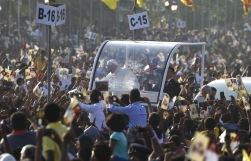
Francis was driven to the palace from his residence at the Vatican embassy in a small blue Volkswagen Touran, in keeping with his simple, no-frills style. Enthusiastic crowds had started gathering four hours before he arrived.
The Philippines has laid on the largest security operation in its history, with about 50,000 police and soldiers on hand. Francis' car was flanked by police vehicles, which sometimes made it difficult for people to see him.
"It has been somewhat of a security nightmare for us," Aquino told the Pope in his address.
Francis was saluted by presidential guards at the Spanish colonial palace and greeted by hundreds of people waving Vatican and Philippine flags. Children rushed up to embrace him as he walked along a red carpet on the palace grounds.
"REJECT CORRUPTION"
The Pope urged government officials "to reject every form of corruption, which diverts resources from the poor, and to make concerted efforts to ensure the inclusion of every man and woman and child".
Since taking office, Aquino has executed wide-ranging reforms in graft-laden agencies such as the customs and internal revenue bureaus, helping improve the Philippines' ranking in watchdog Transparency International's corruption perceptions index (CPI) to 85 last year from 94 in 2013 and 105 in 2012.
But cases of high-level officials in central and local governments misappropriating public funds for personal gain still abound. At least 25 per cent of the country of about 100 million are poor, according to the Philippine statistics agency.
"The great biblical tradition enjoins on all peoples the duty to hear the voice of the poor," he told Filipino leaders.
"It bids us break the bonds of injustice and oppression which give rise to glaring, and indeed scandalous, social inequalities. Reforming the social structures which perpetuate poverty and the exclusion of the poor first requires a conversion of mind and heart," he said.
Aquino said that, while the Church was instrumental in the ousting of former dictator Ferdinand Marcos in 1986, it "suddenly became silent in the face of the previous administration's abuses". Aquino's father was assassinated in 1983 when he returned from exile to oppose Marcos.
The president was referring to the government of former president Gloria Macapagal Arroyo, who has been detained on corruption charges since 2012.
The Mass was celebrated on the same site where a church was first built with bamboo and palm leaves in 1581. Two rows of boys dressed as Swiss Guards lined its steps as he entered. In his homily, Francis said many were still "living in the midst of a society burdened by poverty and corruption".
Later on Friday he was due to hold a rally with Filipino families. As many as 12 million people have left to find work in other countries, making the Philippines the fourth-largest recipient of remittances worldwide.
About half of the population has been affected by decades of labour migration and the strain has come at a significant social cost.
Francis has made defence of vulnerable migrants and workers a central issue of his papacy.