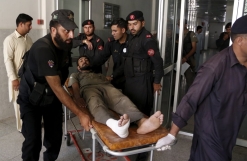
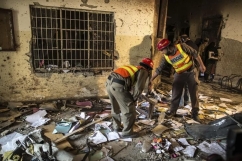
Families of children killed or wounded in Pakistan's worst militant attack accuse the local government of breaking its promises of medical treatment and justice, a year after Taliban gunmen massacred 134 students in a Peshawar school.
Victims' relatives say they will attend the official anniversary commemoration on Wednesday, but vowed to pressure the authorities to deliver on their commitments.
The government promised it would help with medical expenses above an initial Rs400,000 (£2,530) grant, but only 22 of approximately 60 families who applied have received any funds, said Akbar Khan, who represents 124 families of those wounded.
"There are many children who were disfigured, or crippled, who need continuous long-term treatment. And above all, they need psychological rehabilitation," said Khan, whose 17-year-old son Umar was shot in his left arm during the attack.
Muhammad Ibrahim, a provincial health official in the northwestern province of Khyber Pakhtunkhwa, of which Peshawar is the capital, said not all funds had been disbursed because of delays in families submitting receipts for the money they spent.
Khan is among the parents who have also asked the government to facilitate treatment of their children abroad, as it said it would, but have not heard back.
"I have been shot twice in my arm. I have had three or four surgeries, but still need further treatment. And we cannot get that treatment in Pakistan," said Syed Ansar Ali Shah, 16, who has a metal plate holding his left hand together.
According to Khan, just two children, Ahmed Nawaz and Ibrahim Afridi, had received government assistance for treatment abroad so far.
Ibrahim disputed the figure, saying at least six people had been sent overseas with government funding.
The provincial health department is now demanding that the unspent portion of the Rs400,000 grant people received be returned, some families of the wounded say.
"These parents say that their children are not recovered: they cannot sleep, they cannot move properly, and some of them even have bullets still lodged in them," said Akbar Khan.
Health official Ibrahim confirmed that some families had been asked to return funds they had not used.
Azhar Mehmood, 15, was shot four times and has difficulty walking. He still attends the Army Public School where the massacre occurred, but says months of surgery have adversely affected his education.
Mehmood was among several students who complained that the government broke a promise to delay board exams for those children wounded in the attack. As a result, they say, they have lost a year of study.
"I was shot in both my hands, and I wasn't able to write (the exam). I was in hospital at that time. When the exams started, my hands were both in plaster," said Obaid Sajid, 16, who has to repeat the ninth grade.
For the families of the 134 pupils and 16 staff members who were killed, the primary concern is that justice is done.
On Dec. 2, Pakistan hanged four men tried in secret military courts for their involvement in the massacre. All four were said to have confessed to facilitating the attack, the military said in a statement.
Shahana Ajoon, whose 15-year-old son was killed, said she had no faith in the investigation, because it took place behind closed doors and no evidence was made public.
"We do not know who those people were. We should have been taken into confidence. We should have been shown why these were the people who were the culprits," said Ajoon, who sobbed while speaking of her son.
Ajoon and her husband run an organization that provides support to parents of the 134 slain students. Many members said they were still traumatized by events a year ago.
Among them is Aurangzeb Khan, whose 16-year-old son Hassan was killed during the attack.
Khan has left his son's bedroom untouched since the day of the attack. He quit his job months ago, and now spends most of his time either in the room or in a shed that he converted into a shrine to Hassan.
As he speaks, he holds a medal in his hands, a tribute to his son given by the government earlier this year, blackened over time. The medal, he says, is a symbol of the authorities' attitude.
"They use my taxes to clean their jeeps, wearing nice uniforms, eating good food. Look at their houses. (The army) are making merry in their bases, and look at us," he said.