Life from space rocks? Scientists find complex molecules on comet's surface

Did life on Earth actually begin after comets hit the surface of our planet?

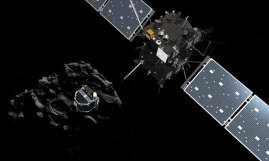
New data obtained by the European Space Agency (ESA)'s comet lander Philae seem to bolster this theory of life from space rocks.

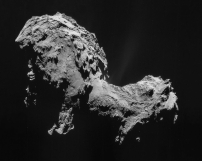
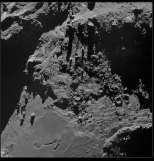
Complex molecules that could be key building blocks of life were discovered on the surface of Comet 67P/Churyumov­Gerasimenko, according to a new research published by ESA scientists in a special edition of the journal "Science."

Four different compounds that have never been detected before in any other comets were found by the Philae lander. These compounds, according to the ESA, "play a key role in the prebiotic synthesis of amino acids, sugars and nucleobases: the ingredients for life."

For instance, the Philae lander detected the complex molecule formaldehyde on Comet 67P/Churyumov­Gerasimenko, which is essential in forming of ribose, which, ultimately features in molecules like DNA present in living creatures.

"The existence of such complex molecules in a comet, a relic of the early Solar System, imply that chemical processes at work during that time could have played a key role in fostering the formation of prebiotic material," the ESA report stated.

The Philae lander also detected gases similar to those found here on Earth such as water vapour, carbon monoxide and carbon dioxide.

Philae lander system engineer Laurence O'Rourke also emphasised the importance of data retrieved from the comet in studying how life began on Earth.

"If you apply energy to such organic compounds ... like a comet hitting a planet ... it could lead to the creation of amino acids which make up proteins, which are the basis of life itself," O'Rourke explained.

Aside from these, the Philae lander also sent data on the daily rise and fall of temperature on the comet, and an assessment of the surface properties and internal structure of the space rock.

related articles
The Rosetta mission and the meaning of life: What space discovery tells us about our place in the universe

The Rosetta mission and the meaning of life: What space discovery tells us about our place in the universe

Glass deposits found on Mars: Life \'conveniently bottled\' on Red Planet?
Glass deposits found on Mars: Life 'conveniently bottled' on Red Planet?

Glass deposits found on Mars: Life 'conveniently bottled' on Red Planet?

\'Hello Earth\': Comet lander Philae wakes up after months of hibernation
'Hello Earth': Comet lander Philae wakes up after months of hibernation

'Hello Earth': Comet lander Philae wakes up after months of hibernation

Alien life on comet? Data from 2 probes shows signs of ancient living organisms

Alien life on comet? Data from 2 probes shows signs of ancient living organisms

First of its kind: ESA mission to Jupiter moons to search for extraterrestrial life

First of its kind: ESA mission to Jupiter moons to search for extraterrestrial life

News
The little-known history of the X in Xmas

Many Christians worry that writing “Xmas” crosses Christ out of Christmas, but the story of the X is an ancient, deeply rooted Christian custom.​ This is the story ….

Large crowds join Tommy Robinson's Christmas carol service

The carol service passed off peacefully despite fears to the contrary.

Who was the historical King Herod?

At Christmas time we read about King Herod who ruled Judea at the time of Jesus’s birth, and he is the villain of many Nativity plays. But King Herod was a real historical character. This is the story …

Christmas evangelistic campaign gets underway

The aim is to reach two million people with the gospel.