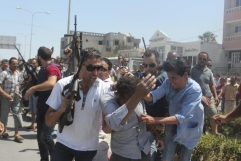
Kuwait identified the suicide bomber behind its worst militant attack as a young Saudi Arabian man and said on Sunday it had detained the driver of the vehicle that took him to a Shi'ite Muslim mosque where he killed 27 people.
The disclosure of the bomber's nationality is likely to focus the attention of authorities probing Friday's suicide attack on ties between Islamists in Kuwait and those in Saudi Arabia, a centre of ultra-conservative Islamic thought.
Kuwait's interior ministry named the bomber as Fahd Suliman Abdul-Muhsen al-Qabaa and said he flew into Kuwait's airport at dawn on Friday, only hours before he detonated an explosives-laden vest at Kuwait City's Imam al-Sadeq mosque.
The Islamic State militant group issued an audio clip purporting to be a posthumous statement by the bomber, in which he criticises Shi'ite Muslims, "especially in Kuwait", for what he terms insulting Islam.
"Very, very soon you will see something unexpected, expect blood, expect death," the speaker says. Reuters was unable to verify immediately the authenticity of the statement.
Saudi Arabia said al-Qabaa was not previously known to security authorities and had flown out of the kingdom to the Bahraini capital Manama on Thursday, state news agency SPA quoted the interior ministry as saying.
The timing of his arrival suggests he had a network already in place in Kuwait. The Kuwaiti interior ministry said it was searching for more partners and aides in this "despicable crime", adding that Qabaa had been born in 1992.
Islamic State's Saudi Arabian arm claimed responsibility for the attack on the mosque, where 2,000 worshippers were praying at the time. It was one of three attacks on three continents that day apparently linked to hardline Islamists.
The attack was the most significant act of Sunni militant violence in Kuwait since 2005, when an al Qaeda-linked group calling itself the Peninsula Lions clashed with security forces in the streets of Kuwait City. Nine Islamists and four security force members were killed in the gun battles.
The bombing has sharply heightened regional security concerns because Islamic State appears to be making good on its threat to step up attacks in the holy fasting month of Ramadan.
The group, seeking to expand from strongholds in Iraq and Syria, says its priority target is the Arabian peninsula and in particular Saudi Arabia, home of Islam's holiest places, from where it plans to expel Shi'ite Muslims.
Islamic State subscribes to a puritanical school of Sunni Islam that considers Shi'ites as heretics.
The interior ministry said the driver of the Japanese-made car, who left the mosque immediately after Friday's bombing, was an illegal resident named Abdul-Rahman Sabah Aidan.
"DEVIANT" IDEAS
The ministry, which had earlier reported the vehicle owner's arrest, said Aidan, 26, was found hiding in one of the houses in the al-Riqqa residential area.
"Initial investigations showed that the owner of the house is a supporter of the deviant ideology," it said, employing a term often used by authorities in the Gulf Arab region to refer to hardline Islamist militants.
The owner of the house, a Kuwaiti citizen, was also detained, the ministry said.
Officials said the bombing was clearly meant to stir enmity between majority Sunnis and minority Shi'ites and harm the comparatively harmonious ties between the sects in Kuwait.
Shi'ites are between 15 and 30 percent of the population of Kuwait, where members of both communities live side by side with little apparent friction.
Kuwait is a conservative Muslim country where alcohol is banned, but it is less strict than Saudi Arabia on issues such as women's rights and freedom of religion.
Kuwaitis reacted with outrage to the bombing. Some said citizens who fund Islamist armed groups fighting in Syria and Iraqwere to blame for any militancy in Kuwait.
Kuwait has been one of the biggest humanitarian donors to Syrian refugees through the United Nations, but it has also struggled to control unofficial fund-raising for opposition groups in Syria by private individuals.
Abdulrahman al-Jeeran, a parliamentarian and member of the ultra-conservative Salafi branch of Islam, told Reuters lawmakers should stop "sectarian discourse" and be prevented from using sectarian issues for electoral gains.