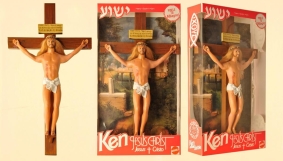
Even before it opened, the controversial exhibit called "Barbie, The Plastic Religion" had already drawn outrage and criticism from Catholics in Buenos Aires, Argentina, which happens to be the birthplace of Pope Francis.
Still, the exhibit pushed through, with 33 Barbie and Ken dolls depicted as religious figures. Barbie has been made into the Virgin Mary while Ken was shown as the crucified Jesus Christ, according to Charisma News.
"Barbie and Ken have offered for decades a model of a couple that attracts children of every age to play with them and identify with them," said Adrian Santarelli, a priest at St. Thomas More parish in Buenos Aires. "The idea of dressing [dolls] with sacred images of sacred persons alters and damages the child's levels of understanding of the sacred."
"Could we consider normal that a child prays to Barbie?" he added.
In their defence, artists Marianela Perelli and Emiliano Paolini, who are the brains behind the exhibit, said they did not mean to offend anyone. They explained that the exhibit, which will be on display until Nov. 20 at the POPA art gallery in Buenos Aires, is just an expression of art.
"It was simply the union of the two most popular elements of history: the Barbie doll and religion," Paolini said.
On the other hand, Perelli believes that some people jumped to the wrong conclusion about the goal of their exhibit. "I think that our work was misinterpreted, and [people opted for] a defensive position on an artwork that was not believed to be offensive, but it seemed that it was hiding something terrible, suspicious," Perelli said. "I think that Barbie has a bad reputation, but the reality is that she's the most widely sold doll to children. So why do people think she's like a prostitute?"
Aside from the Virgin Mary and Jesus, other religious figures depicted were Joan of Arc, Mexico's patron saint Virgin of Guadalupe, and Mary Magdalene. As for Ken, he also portrayed Buddha and Moses.
Other religious groups such as Hindus were also enraged over the exhibit, since the dolls were used to depict their goddess Kali. Rajan Zed, who is a Hindu cleric living in Nevada, called the "Barbie-fication of Kali" as "simply improper, wrong and out of place."
Several people do not share the religious groups' views though, and believe that faith-based groups should not let their ideals be stuck in the past.
"For me, this exhibition is not controversial," said Juan Villanueva, a curious art onlooker. "Using religious figures with dolls is an artistic technique which produces a nice work."
"We can't be stuck in the past with our traditions," added Elina Aguilar, a retired woman. "It doesn't outrage me."