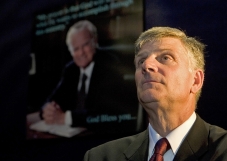
God can never forgive person who refuses to seek His forgiveness, says Billy Graham

No sin is too big or too small for God not to forgive, and all people have to do is repent with open hearts and accept his forgiveness, legendary American evangelist Billy Graham once said.

He quoted the Bible verse Isaiah 55:7 to shed light on God's approach to forgiveness. It says: "Let them turn to the Lord, and he will have mercy on them, and to our God, for he will freely pardon."

"The only person God can never forgive is the person who refuses to seek his forgiveness. Why, then, would anyone refuse to turn to God and seek his forgiveness? Why would anyone refuse the gift of eternal life God offers to all who put their faith and trust in Christ?" he wrote in an article for the Kansas City Star.

Throughout his years of preaching, Graham learned that some people refuse to turn to God and seek forgiveness because they are afraid God will reject them and refuse to forgive them.

Others, on the other hand, refuse because they want to keep on living the sinful life they've always lived, while others simply refuse because they hate God and do not want anything to do with Him.

"But whatever their excuse, there's no reason for anyone to turn away from God and refuse his gift of forgiveness — a gift that Christ purchased at the cost of His life. God loves you, and no matter what your past has been, God wants to forgive you and welcome you home," said Graham.

He urged people not to risk their souls to eternal damnation any longer, because the Bible (Hebrews 10:31) warns, "It is a dreadful thing to fall into the hands of the living God."


related articles
Heaven is real and far more glorious than anything in the universe — Billy Graham

Popular American evangelist Billy Graham once assured people that heaven is absolutely real, and that it is far more glorious than anything in the entire universe.

Franklin Graham thanks his parents for  exemplifying \'Christ-centred marriage\'
Franklin Graham thanks his parents for exemplifying 'Christ-centred marriage'

Reverend Franklin Graham has gone on a trip down memory lane as he honoured his parents Billy and Ruth Graham's wedding anniversary, and he thanked them for best exemplifying what it means to have a marriage that is centered on Jesus Christ.

Where did Franklin Graham come from?

While Billy Graham was known for building coalitions around sharing the Gospel and became the figurehead for uniting diverse groups under the banner of evangelicalism in America, the story of his son Franklin suggest that parts of the elder Graham's legacy are in danger of being lost.

News
Faith in difficult times: lessons from 1930s Britain

Architectural historian Steven Brindle talks to Christian Today about the faith that shaped 1930s Britain, the churches that supported struggling communities and what lessons the decade might have for us today.

Campaign aims to mobilise 500,000 Christians for Christmas outreach

Shine Your Light is aiming to mobilise half a million Christians to share the gospel with five million people across the UK this Christmas, with more than 2,000 churches already signed up, organisers say.

The Church of England should repent for previous calls to ban 'conversion therapy'

The Church of England's uneasiness about the government's ‘conversion practices’ bill is a perfect lesson in the old adage, 'be careful what you wish for,' writes Dr Martin Davie.

Leaked Home Office report links 'Christian extremism' to traditionalist beliefs and immigration concerns

An internal Home Office report lists concerns about immigration, multiculturalism and changing social values among the characteristics associated with what it calls "Christian extremism", it has been reported.