The Lebanese government has started demolishing the homes of Syrian refugees that do not comply with new regulations despite warnings from World Vision and other development agencies that it will put families affected at risk.
The first of the demolitions started early on Monday morning in Arsal, eastern Lebanon, with at least 20 homes already torn down, World Vision said in a joint statement with Save the Children, the Norwegian Refugee Council, the Danish Refugee Council, the Terre des Hommes Foundation, and Action Against Hunger.
At least 15,000 Syrian refugee children are at risk from the new regulation announced in April ordering the deconstruction of all "semi-permanent structures" built by Syrian refugees using materials other than timber and plastic sheeting. Under the new regulations, the shelters may not include any permanent walls higher than five rows of bricks.
"The presence of soldiers in those camps at dawn, and the demolition of homes with heavy machinery is a traumatizing event witnessed by families who had already lost everything," the development agencies said.
They criticised the Lebanon government for failing to provide any alternative for the refugees affected by the demolition order, and putting increased pressure on them to return home.
"Depriving refugees of their already very basic shelter and leaving them out on the streets is not a solution," the agencies said.
"The demolitions in Arsal come in the context of deteriorating conditions for Syrian refugees, who in the past months have faced an increasingly coercive environment making their lives even harder.
"We call on the Lebanese authorities to continue to show compassion to refugees who depend on Lebanon for their safety and dignity."
They went on to warn that forcing refugees to live in tents "creates substantial health and safety risks", and increases their exposure to the weather, ranging from scorching heat in the summer to bitter cold in the winter.
The statement concluded with a call to the Lebanese government to host refugees "with dignity" and protect basic needs like schools, health facilities, water and sanitation.
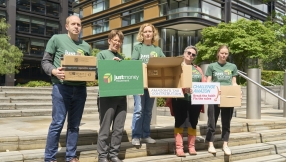
The call came as World Vision UK presented the Department for International Development (DFID) with a petition demanding increased spending to stop children being abused and assaulted in disaster zones.
The petition was signed by 34,000 people in the UK and asks DFID to commit to raising spending on safeguarding projects by at least 10 per cent of the humanitarian budget.
Rhian Beynon, Campaign Manager at World Vision UK, says: "Five hundred and thirty-five million children are living in a country affected by conflict or disaster.
"In these crises – conflicts, natural disasters, epidemics – children and young people suffer the most while being the least responsible.
"They are particularly vulnerable to violence such as being recruited to child soldiers, sexual abuse, trafficking and hazardous labour. The UK government must step up its investment to keep them safe."