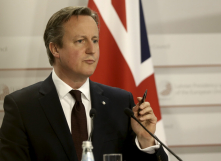
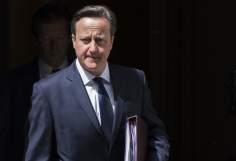
The prime minister delivered a major speech on religious extremism yesterday in Birmingham. On the same day, just up the road, the Archbishop of Canterbury gave a significant lecture on Religiously Motivated Violence (RMV) at Liverpool John Moores University.
Laying into politicians for their lack of religious literacy, Justin Welby specifically said he wasn't talking about Mr Cameron's speech.
In fact, after a typically insightful and thought-provoking account of what creates RMV and how we can combat it it, he said this: "At the middle, governmental level, we need to ensure that we are equipping our decision-makers with faith literacy that has the power to improve our global situation."
He continued: "We must greatly improve the quality with which leaders understand the cultures and beliefs of others, so that dialogue and decisions can take place through genuine understanding rather than poorly nuanced preconceptions and prejudices. I am not referring to the Prime Minister's speech today, for the avoidance of doubt."
However, two speeches on religious extremism on the same day by the leaders of the Government and the Church are crying out for a "compare and contrast". And with the greatest respect to Cameron, Welby is the one who gets it.
In his Birmingham speech, among much that is challenging but sensible, Cameron reverts to an old theme of his: the need to tackle extremism upstream, before it turns violence. He speaks of the "passive tolerance" of ideas and practices that are basically un-British. "You don't have to support violence to subscribe to certain intolerant ideas which create a climate in which extremists can flourish," he says, instancing "ideas which are hostile to basic liberal values such as democracy, freedom and sexual equality. Ideas which actively promote discrimination, sectarianism and segregation. Ideas – like those of the despicable far right – which privilege one identity to the detriment of the rights and freedoms of others."
He also rubbishes the idea – unbelievably – that young Muslims are radicalised because of Western foreign policy, or poverty, or because they have a reasonable belief that the world has got it in for them. Instead, they are preyed upon by evil recruiters who deceive them into thinking that terror is a good thing.
There's much in his speech that anyone could applaud. But it's impossible to read it without seriously worrying that Cameron's desire for Muslims is that they conform their religion to his idea of a liberal English gentleman. The problem is that this means the victory of a particular ideology – and no religion, whether Muslim, Christian or Jedi, is going to take that lying down.
I don't want a government that tells Christians how to be Christians or Muslims how to be Muslims. But when Cameron argues that "No one becomes a terrorist from a standing start," he's opening the door to the kind of scrutiny and regulation of belief and doctrine that is exactly that.
So when he says that "democracy, freedom and sexual equality" are "basic liberal values", I might agree with him – but I still want the freedom to ask what these actually look like, and to dissent from the majority if I choose. I think that Christian complementarianism, which prescribes certain gender roles for women, is pernicious nonsense, but I don't want it to be outlawed by a government watchdog. Of course, it won't be – but in Cameron's world, a Muslim family lacking Christian privilege is at far greater risk of this sort of interference.
The widespread illiteracy among media and government about religion was demonstrated again only last week on Tim Farron's election as Liberal Democrat leader. As an evangelical Christian, he was subjected, among many other things, to absurd questions about his views on the Levitical proscription of gay sex – as though it's simply impossible that someone should hold a liberal political position alongside a conservative personal one. But in Cameron's world, these are precisely the sort of views that should be challenged.
So the Archbishop's call for a better quality of dialogue is very timely. There's no reason to think that he would disagree with everything that Cameron said. But he speaks powerfully of the need for "face to face" encounter rather than conducting high-volume arguments on social media. He speaks of the need for working together on the great problems of the day rather than in opposition. "Through face-to-face dialogue – by making the localisation of the global work for mutual advantage across different groups – we begin to chip away at the walls that have been erected to separate us," he says.
Welby is not a softy. He calls for "realistic and pragmatic" approaches to security, including a renewed UN mandate. But, he says: "Effective faith literacy requires not only knowledge but an emotional intelligence that enables us to understand the place of faith in other people's lives."
And this face-to-face understanding, he believes, is a profoundly spiritual exercise, reflecting the "transformational power of coming face to face with Jesus Christ". So, he says, "In this way, we will be better able to recognise the diversity and value of each and every human face. And I will say, as a Christian, to recognise the face of God."
Truly engaging Muslims in the struggle against Muslim extremism is an extraordinarily difficult task. But it's far from clear that Cameron has demonstrated the emotional or spiritual intelligence required to see the face of God in someone of another religion. Of course, as prime minister it is not his business to do so. However, he must at least help to create the conditions in which the work of encounter can take place: as Welby says, citing Pope Benedict, "In our face-to-face interactions, we give of ourselves, and in doing so, open up the possibility of a new dialogue and new relationships based on common humanity, rather than on power."
The trouble is that in his account of them, liberal values look far too little like cultural hospitality and far too much like cultural imperialism.
Follow @RevMarkWoods on Twitter.