
Attackers armed with bombs and guns opened fire at church services at a Nigerian university, killing about 20 people as worshippers tried to flee, witnesses and officials said.
"Explosions and gunfire rocked Bayero University in the northern city of Kano, with witnesses reporting that two church services were targeted as they were being held on campus," said a report from the AFP news agency.
One of the services was being held outdoors, while the second was inside a building in a lecture theatre, but with an overflow audience outside, witnesses said.
Lieutenant Iweha Ikedichi told AFP that it appeared the attackers, who arrived in a car and two motorcycles, used bombs and gunfire in the assault.
A witness told the AFP news agency the attackers had first thrown in explosives and fired shots, "causing a stampede among worshippers," adding, that "they now pursued them, shooting them with guns. They also attacked another service at the sporting complex."
Another witness spoke of "pandemonium," and said he had seen two men shooting indiscriminately.
Officials were unable to confirm casualty figures, but an AFP correspondent counted six bullet-riddled bodies near one of the two sites.
At least another dozen bodies could be seen on a roadside by the university, but the exact number was unclear.
Musical instruments and half-eaten meals could be seen at the site of one of the services.
An army spokesman confirmed the attack but could not provide a casualty toll.
The BBC said in its report, "No group has said it launched the attack, but the violent Islamist Boko Haram group is active in Kano. It has recently attacked churches."
Mohammed Suleiman, a history lecturer at the university, said security guards had to run for their lives when the violence broke out.
Nigeria's central government has struggled to contain the militant group, which operates mainly in the predominantly Muslim north, but has also struck as far south as the capital, Abuja.
Kano state police spokesman Ibrahim Idris said that by the time police arrived, the attackers had "disappeared into the neighborhood." A manhunt is under way.
But the situation at the university was now calm, according to the Red Cross spokesman.
Boko Haram carried out a bombing in Kano in January that killed more than 180 people, its deadliest attack to date.
A Red Cross spokesman said adults - possibly professors - and three women were among the casualties. Several needed urgent blood transfusions.
Mark Lobel of BBC News, based in Lagos, said, "Police say small explosives inside soft drink cans were used in the attack on the university campus in Kano - trademarks of the Islamist group of Boko Haram. There are other signs pointing to them - the use of attackers on motorbikes for instance.
Alf and Anne Wooding pictured on their
wedding day in Kano
"The attack - on an apparent Christian service at an education establishment - would match up to threats the group has made in the past. Their name Boko Haram, translated from the local Hausa language, means 'Western education is forbidden.' It is a good reflection on the group.
"Its purported aim is to destabilize the Nigerian state. Following the failure of talks to get the group to relinquish violence, the government in Abuja has conducted a number of crackdowns. But it appears to be unable to confront the group that is attacking Nigeria on a new front almost every week."
-

Sharing your faith: practical tips for evangelism
-

‘The UK is a mission field’ - churches encouraged to embrace cross-cultural mission on their doorstep
-

Hillsong’s Joel Houston opens up about season of 'soul-searching' after difficult few years
-

The Conversion Practices Bill is weaponised vagueness
News
-
Priest dies after cross falls on him during livestreamed Mass
-
John Lennox urges Christians to overcome fear of sharing their faith
-

The Conversion Practices Bill is weaponised vagueness
-

Anti-Christian harassment continues to rise in Jerusalem
-

Christians remember Aberfan disaster 60 years on
-

Young people are finding their way to the Christian faith through media, says bishop
Most Popular
News
Christian widows in Nigeria hold fast to faith as they rebuild lives after violence
Hundreds of Christian widows in Nigeria’s Plateau State are putting their lives back together after losing husbands, homes and livelihoods to violence.
8 killed in attack on church in Jordan
In response to the shooting, Church leaders vowed that Christians will not be driven from their homeland.
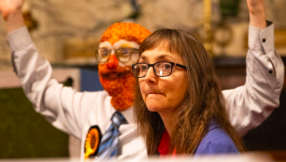
The Christian candidate who lost the election but won my respect
Helen Spiby-Vann secured just 63 votes in the Holborn and St Pancras by-election, but her campaign made me reconsider the value of an explicitly Christian voice in politics, writes Christian Hacking.
Can we afford the society we have created?
Is spending spiralling out of control? Should the state be doing everything we expect of it, or can we simply no longer afford the society we have created?








