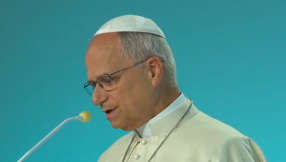
Questions have been raised over the authenticity of the so-called 'filial correction' in response to Pope Francis' 2016 document on the family, Amoris Laetitia, after one of the supposed signatories revealed that he had not, in fact, signed.
Alejandro Bermudez, the executive director of the respected Catholic News Agency, yesterday issued a brief statement saying: 'I was surprised to see that my name has been added to the list of signatories on the so-called Correctio Filialis De Haeresibus Propagatis. I never signed this letter, nor do I intend to ever sign it. As a journalist, I was surprised at how easily the name of a person could be added to the list without any verification.'
In his encyclical Amoris Laetitia ('The Joy of Love'), Pope Francis infuriated traditionalists by writing that in some circumstances Catholics in their second marriage could receive Communion.
He has since been attacked by a range of Catholics ranging from Cardinals to internet trolls and on Sunday, a bishop and several dozen priests, scholars and writers published what they described as a 'filial correction' of some of Francis's teachings about marriage, especially about access to the sacraments for divorced and civilly remarried Catholics – or 'unrepentant adulterers' in the language of conservative Catholics.
In the Spanish version of his statement, Bermudez added that in an email exchange with Joseph Shaw, a spokesman for the filial correction, he had written that the appearance of his name without permission 'speaks volumes about the lack of seriousness of this initiative,' adding: 'Please remove my name immediately.'
The discrepancy was revealed as it emerged that a leading Catholic philosopher is suing an archdiocese after the local archbishop fired him from a Catholic university for publishing a critique of Amoris Laetitia.
According to Lifesitenews.com, Dr Josef Seifert filed a civil lawsuit last week against the Archdiocese of Granada saying that his removal from the International Academy of Philosophy was unjustified and a violation of his human and constitutional rights.
Seifert, who is what Lifesite called 'an intimate friend' of the late Pope St John Paul II, was removed in August from his post at the International Academy of Philosophy in Granada by Archbishop Javier Martínez Fernández.
In an article published online last month, Seifert described Amoris Laetitia as a ticking 'theological atomic bomb' that has the capacity to destroy all Catholic moral teaching.
The article referred to the question of Communion for the divorced and remarried, known in the Church as being in a state of 'adultery', saying: 'If this is truly what AL [Amoris Laetitia] affirms, all alarm over AL's direct affirmations regarding matters of changes of sacramental discipline refer only to the peak of an iceberg, to the weak beginning of an avalanche, or to the first few buildings destroyed by a moral theological atomic bomb that threatens to tear down the whole moral edifice of the Ten Commandments and of Catholic moral teaching.'
Archbishop Fernández made it clear in a statement on August 31 that Seifert's removal was indeed because of the article which, he said, 'damages the communion of the Church, confuses the faith of the faithful, and sows distrust in the successor of Peter, which, in the end, does not serve the truth of faith, but, rather, the interests of the world.'
In Amoris Laetitia, Pope Francis asked pastors to 'accompany' those who have remarried civilly; to check whether their sacramental marriage was valid or if they could receive a decree of nullity; and to lead them in a process of discernment about their responsibility for the breakup and about their current situation in the light of Church teaching. The document reflected discussions and conclusions from meetings in 2014 and 2015 of the Church's Synod of Bishops on the family.
This week's 'filial correction' lists what its authors see as seven 'false and heretical propositions' in Amoris Laetitia including, allegedly: a belief that God's grace does not give a believer the strength to meet 'the objective demands of divine law'; that divorced and civilly remarried persons 'are not necessarily in a state of mortal sin'; that a person can break divine law and not be in a state of sin; that a person can decide in good conscience that sexual relations are morally permissible or even good with someone other than the person they married sacramentally; and that 'our Lord Jesus Christ wills that the Church abandon her perennial discipline of refusing the Eucharist to the divorced and remarried'.
The letter asked the Pope publicly to reject the seven propositions.