
Christian groups have called into question a declaration urging Christians to vote according to their conscience in the General Election.
The Westminster Declaration urges Christians to vote with three issues particularly in mind - protecting human life, protecting marriage, and protecting freedom of conscience.
It has been signed by more than 36,000 Christians, including former Archbishop of Canterbury Lord Carey, the head of the Evangelical Alliance Steve Clifford, and the head of the Catholic Church in Scotland Cardinal Keith O’Brien.
The declaration has met with strong criticism from Faithworks, which has stated it will not be signing it.
The influential ministry, which resources Christians for community engagement, criticised the Westminster Declaration for suggesting that “government should be chosen according to their responses to only three issues – protection of human life, marriage and conscience – rather than the impact of the spectrum of their policies locally, nationally and internationally”.
According to The Church of England Newspaper, the group said: “The Westminster 2010 Declaration sets Christians up on a moral high ground and implicitly creates divisiveness. It does this at just the time when the church’s morality has been called into question across the world.”
Senior representatives of the three main parties will be asked to sign the Westminster 2010 pledge, distinct from the declaration, at a major hustings event in Westminster on Monday. The pledge asks that parliamentary candidates “respect, uphold and protect the right of Christians to hold and express Christian beliefs and act according to Christian conscience”.
Cross-party group, Christians in Politics, also expressed its concerns about the declaration. It said that while there was “much to commend” about Westminster 2010, it added that there was “much to question about its timing, depth and tone”.
“It has also been inevitably hampered by the lack of consultation with Christian Parliamentarians and the main Christian groups involved in praying and serving with our political infrastructure,” it continued.
“There is also a danger that people will judge the faith of a Christian standing for election, merely by whether or not they have signed this pledge. We urge people not to do so.”
Faithworks is encouraging supporters to sign its own Faithworks Declaration, asking that the next Government take steps to ensure that faith-based groups are supported rather than treated with suspicion or discrimination.
The declarations have been issued as Christian groups seek to mobilise the churchgoing portion of the electorate to engage with the General Election.
CARE (Christian Action Research Education) said the number of church hustings events registered on its election website had exceeded all expectations.
Nola Leach, CARE’s chief executive, said: "When we set out we hoped we might get 50, never expecting that two weeks into the campaign we would have over 200!
"We continue to be unaware of any larger single source of hustings. It’s wonderful to see the church playing such a strategic role during this election."
-

Are we seeing the end of Western civilisation?
-

The dire American political situation: a brief overview for faithful Christians in Britain
-
Police appeal for witnesses after head smashed off Jesus statue at church war memorial
-

Poll shows support for conversion therapy ban disappears once people learn its implications
News
-

Former Crowded House pastor and wife charged with rape
-

Enoch Burke accuses Archbishop of remaining 'silent' in school trans dispute
-

The dire American political situation: a brief overview for faithful Christians in Britain
-

Police appeal for witnesses after head smashed off Jesus statue at church war memorial
-

Half of Christian questions on ChatGPT are attempts to understand the Bible
-

Archaeologists may have discovered identity of mystery skeleton in Westminster Abbey
Most Popular
News
Why the US election results do not bode well for America
Only a return to genuine biblical Christianity can save America from itself.

AI and the Gospel: navigating faith and evangelism in the digital age
As AI changes the way people search for answers, build relationships and explore faith, churches are facing new questions about how to engage with technology without losing the human connection at the heart of the Gospel. Christian Vision’s Heinz Oldewage shares his thoughts.

The three-way squeeze on Christian education
Churches, charitable societies and Christian families created schools because they understood education as the formation of the whole person under God. Now the state behaves as though every educational freedom exists by its permission. It does not.
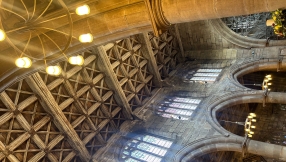
Historic Lancashire church awarded £614,000 towards restoration of Elizabethan ceiling
The money will go towards restoring its centuries-old Elizabethan ceiling and improve facilities for worshippers and the wider community.





