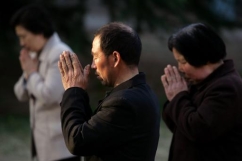
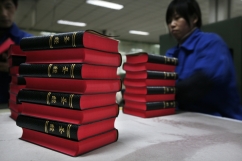
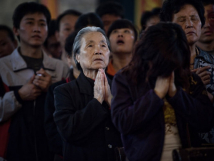
Officials in China's Zhejiang province have reaffirmed that members of the Communist party (CPC) must categorically reject all religion.
Only applicants who renounce religion will be accepted, a party authority said on Friday. Those wishing to join the CPC, which currently has at least 80 million members, will be required to undertake a course on Marxism, and anyone found to have participated in religion in the past will have to "rectify" their beliefs.
As the CPC is officially atheist, members have never been able to publically hold religious beliefs. Friday's announcement, printed in the state-run Global Times newspaper, however, suggests that the pre-examination system for recruiting party members has not always been upheld forcefully. It should be "improved and implemented," authorities said.
The comments are thought to be part of a wider crackdown on Christianity in Zhejiang, and particularly the city of Wenzhou – also known as the 'Jerusalem of the East' due to its thriving Christian population.
Christians in the region believe that the Government is specifically targeting them as part of its bid to retain complete control. Estimates vary, but over 300 churches are thought to have been demolished in recent months, while others have had crosses removed.
Li Yunlong, a professor at the Party School of the CPC Central Committee, told the Global Times that "Party members are banned from joining religions. Believing in communism and atheism is a basic requirement to become a party member."
"This could be a part of efforts against the penetration of western hostile forces," he warned.
The CPC is the largest political party in the world, and membership is considered to be a good networking opportunity. Many ordinary civilians, particularly young people, therefore join in the hopes of furthering their career. However, for those with a faith, it's not an easy decision.
"Churches in Beijing and Shanghai in particular are mostly drawn from the middle classes; white collar workers and well-educated young people from relatively comfortable families, and so for them, applying for party membership would be a part of meeting their career goals," a country expert told Christian Today in November.
"But it presents a problem for them; should they officially renounce their religion but practise it discreetly, or leave the Church completely, or not apply to join the party at all?"
Speaking anonymously, the spokesperson from Christian Solidarity Worldwide (CSW) added that there has been a "knock on effect" for Christians following the introduction of a hard-line approach to various parts of civil society by President Xi Jinping.
"There's been talk about having to making sure that churches in China follow a Chinese Christian theology, and at the same time Xi Jinping has talked more than pervious leaders about returning to traditional beliefs," she said.
"All of this has left some Christians to fear a change in the political climate for churches in China."
Although the right to freedom of religious belief is guaranteed under Article 36 of the Chinese Constitution, that protection is limited to those who worship within state-sanctioned religious bodies. Those who choose to practise their faith outside of these, or whose beliefs are not officially recognised by the government, are at risk of being accused of participating in illegal activities, which carries heavy punishment.
Last year, a senior a senior official within the CCP, Zhu Weiqun, was forced to dismiss allegations that widespread corruption in the party is due to a lack of religious belief.
In a piece for the Global Times, he said that a ban on religion is "the important ideological and organisational principle which has been upheld since the founding of the party. There is no doubt about it."