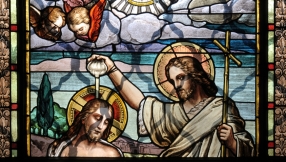
The number of Catholic baptisms taking place across the whole island of Ireland has fallen by almost 30% over the past decade, with declining birth rates and the growth of religious non-affiliation identified as the main reasons.
A new briefing note from The Iona Institute, based on figures supplied by almost every Catholic diocese in Ireland, found that baptisms were down 29.6% compared with a decade earlier.
The institute estimates that around 60% of that fall can be explained by the decline in births, with the remainder linked largely to secularisation.
Births across the island dropped by 18.8% over the same period, including a 17.9% decline in the Republic of Ireland and a 21.3% fall in Northern Ireland.
The fall in baptisms was far from uniform, however.
Figures published in the report show that Dublin recorded one of the steepest declines, with baptisms falling from 15,759 in 2015 to 9,465 in 2025, a drop of 39.9%.
Meath saw an even slightly larger proportional fall of 40.8%, while Down and Connor, which includes Belfast, recorded a 37.9% decline.
By contrast, Achonry saw baptisms fall by just 3.2%, while Elphin recorded a small increase of 0.9%. Kerry’s decline stood at 22.3%.
The Iona Institute said the figures should not be interpreted as evidence of secularisation alone, arguing that the shrinking number of children being born has had an even greater effect.
Census figures cited in the briefing also show a marked shift in the religious identity of young children in the Republic.
Over three quarters (78.3%) of children aged between zero and four in 2016 were recorded as Roman Catholic. By 2022, that had fallen to 65.4%.
Over the same period, the proportion recorded as having no religion rose from 9.2% to 15.6%.
The total number of children aged under five also fell by more than 37,000 between the two censuses.
Despite those changes, the institute said the data suggests that the “vast majority of parents who identify as Catholic still have their children baptised.”
In the 2022 Census, 67.9% of mothers aged 25 to 39 with children under five identified as Roman Catholic, closely matching the 65.4% of children in that age group who were recorded as Catholic.
It described this as evidence that “cultural Catholicism is still quite strong in Ireland,” even as regular churchgoing and participation in other sacraments have weakened.
The briefing notes that some Catholic couples marry outside the church but still choose baptism, First Holy Communion and Confirmation for their children.
Dr Tom Finegan, chairman of The Iona Institute, said the overall decline was unsurprising “given the rapidly falling number of births and growing secularisation.”
“Given that births have fallen by almost a fifth in the last ten years, and more people are ticking the ‘No Religion’ box in the Census, we could expect nothing but a big drop in baptism figures,” he said.
He added that the figures also point to the continuing strength of ‘cultural Catholicism’ in Ireland, with many parents who still identify as Catholic continuing to have their children baptised.
Regional differences appear to reinforce the role played by both demographics and secularisation.
In Dublin, births fell by 21.9% between 2015 and 2025, compared with 17.9% across the Republic as a whole.
The capital also has a higher proportion of young children recorded as having no religion. In the 2022 Census, 21.9% of children aged under five in Dublin were in the “no religion” category, compared with 15.6% nationally.
A similar picture emerges in Belfast.
Census figures for Northern Ireland show that 25.5% of children aged under five in Belfast were recorded as having no religion in 2021, up from 17.5% in 2011.
Among women aged 25 to 44, the proportion with no religion rose from 14.4% to 25.2% over the same period.
Dr Finegan remarked: “The fall in baptisms must be seen not simply as the result of secularisation, but even more as a result of falling births.”
He also pointed to Ireland’s fertility rate, currently standing at about 1.5 children per woman, compared with the 2.1 needed for population replacement.
“This should be of concern to everyone, regardless of religious belief,” he said.
The briefing concludes that Ireland’s baptism decline reflects two trends happening at the same time: there are fewer children being born, and a growing share of families no longer identify with any religion.
“As almost all parents who consider themselves to be Catholic still have their children baptised shows that ‘cultural Catholicism’ still remains quite strong in Ireland,” it stated. “It remains to be seen what happens to baptism numbers if and when ‘cultural Catholicism’ fades as a force in Irish life.”