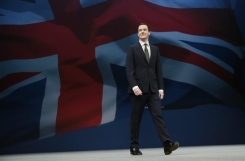
A defeat for proposed welfare cuts in Britain's upper house of parliament was widely seen on Tuesday as a deep blow to Chancellor George Osborne, leaving him "isolated" and "humiliated" after he asked the country to live within its means.
Forced to backtrack on cuts to benefits for low-earning families, Osborne's determination to push through measures critics said would hurt Britain's most vulnerable people was deemed ill-judged by newspapers and some lawmakers.
He is widely seen as the frontrunner to succeed Prime Minister David Cameron, but the defeat in the House of Lords on Monday struck at the heart of his attempts to broaden his appeal to blue collar workers and claim the political centre ground.
It also blows a £4.4 billion hole in his plans to wipe out Britain's deficit – a policy championed by Osborne which helped spur the Conservatives to a resounding victory over the opposition Labour Party at the election in May.
Opposition lawmakers jumped on the forced U-turn by the minister, who last week said he was "comfortable" with the changes despite the growing criticism.
"The chancellor is in denial," deputy leader of the Scottish National Party, Stewart Hosie, said in parliament.
"Is it not the case...that yesterday the 26th of October demonstrated two things: The chancellor has lost his political touch, and his chance of being prime minister has just gone up in a puff of ermine-clad smoke."
Britain's biggest selling newspaper, the Sun, an influential supporter of the Conservative Party, splashed "Borne loser" on its front page, playing on the Chancellor's surname.
It said Osborne was left isolated after being "forced into a humiliating climbdown on his huge cuts to tax credits after crushing defeats in the House of Lords".
The upper house broke with long-standing political convention by voting to reject a financial measure. It called on the government to find ways to help those who would be left worse off, such as single parents and the self-employed.
The vote followed weeks of criticism over the cuts, which the independent Institute for Fiscal Studies said would make 3 million households worse off by, on average, £1,300 a year.
Osborne had said Britain could cut the tax credits because of a higher minimum wage, due to rise to more than £9 an hour by the end of the decade. But critics, including members of his own party, said such increases followed the cuts too slowly.
Mounting criticism
Earlier this month, Heidi Allen, a Conservative lawmaker, used her first speech to parliament to criticise the pace of the cuts, saying the government was sending "a message to the poorest and most vulnerable in society that we do not care".
Unbowed, the Chancellor, often credited with being the political brains behind Cameron's leadership, said on Tuesday he would carry on with his tax credit reforms to "save the money needed so Britain lives within its means".
"We remain as determined as ever to build the low tax, low welfare, high wage economy that Britain needs," he told a rowdy session of parliament.
But he may have to lower his target for a budget surplus by the end of the decade. He said in July he would save £12 billion a year from the welfare budget by 2020, and the cuts to tax credits would have accounted for about a third of that plan.
Conservative members moved to close ranks behind him, taking aim at the unelected House of Lords which, some said, by breaking with convention had produced a constitutional crisis.
Cameron said he would launch a "rapid review" of the house which, with its many elderly members and their ceremonial fur-fringed red robes, can seem like an anachronism. Its defenders point to the wide-ranging expertise of its peers and a tradition of acting as a counter-balance to politicians.
Boris Johnson, the London mayor, seen as a rival to Osborne for the Conservative Party leadership, said the chancellor was right to reform tax credits.
Osborne said he would offer some ideas on how to soften the impact of the cuts on November 25, when he presents a planned budget update as well as a plan for further cuts in government spending.
"I have said I would listen and that's precisely what I intend to do," Osborne told broadcasters.