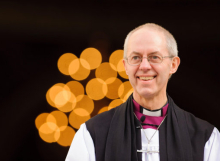
The Archbishop of Canterbury today reaffirmed his commitment to evangelism, telling the Church of England's General Synod that it is "the calling of the whole Church".
Addressing the synod in London this afternoon, the Archbishop opened his presidential address with a joke at his own expense.
Noting that many Christians respond to the thought of witnessing with "nervousness, uncertainty and guilt" rather than delight, he said: "The strategic response to this is clearly for a long-term, iterative and interactive, metric-based, evidence generated development of competencies across the widest possible range of stakeholders in order to achieve maximum acceleration of disciple input with the highest possible return on effort and capital employed.
"That last paragraph is, of course, complete rubbish. To be honest, I just put it in in order to reassure you, as it is well known that I am in fact a businessman who put on the wrong clothes this morning."
In his first presidential address to the synod last July, Welby labelled evangelism as one of his three main priorities in ministry. "We need new imagination in evangelism through prayer, and a fierce determination not to let evangelism be squeezed off our agendas," he said.
Today, he returned to this commitment, telling the synod: "Witness and evangelism are expressions of the overflow of the love and joy of the grace of God into our lives, and the life of His whole Church and His whole world."
Sharing the Good News should be "about as guilt-inducing as breathing", he added. "They are as much a part of the life of the Church as worship."
The Archbishop said, however, that St Paul's assertion that the "love of Christ urges us on" in evangelism is not always evident in the Church of England.
The final aim of the Church is to call Christians "to be those who worship and adore God in Christ, overflowing with the good news that we've received, making Christ known to all so that the good news is proclaimed effectively throughout the church," he said.
"It is the most compelling of announcements. It comes as a gift to us, not of our own creation. It is news because it tells us of what we do not already know. We have not deduced it ourselves or worked it out by our own power of reason: the good news is the power of God.
"In our good news we speak of Him who really does not sweep our human needs, concerns, cares, desires and problems under the carpet, but takes them up and makes them His own.
"And if we allow ourselves to be gripped by this gospel, this good news of Jesus Christ, it will overwhelm us, for it seems too good to be true. As Pope Francis said in Evangelii Gaudium: 'the Gospel constantly invites us to rejoice'."
It is a constant challenge to Christians, Welby concluded, and the Church must work to encourage and facilitate the witness of believers. "That change will not just happen, we can't just hope for something magical to occur," he said.
"My fear is that many of us have lost all confidence in the Gospel. We have thought that you need to be an expert or a professional to be a witness. But we do not. We simply need to be able to tell of the love that has grasped hold of us and the difference it has made in our own lives."
Despite significant debate about falling attendance figures in the UK, Justin Welby has previously insisted that he has no fears for the future of the Church.
"But I would really like, and I believe it's part of God's plan, that that future of the church of God includes a renewed, invigorated, confident, wonderful, celebratory, humble, delighting Church of England," he said in November. Evangelism isn't about using God "to ensure the Church keeps going", he added.
"What you're doing in evangelism isn't a tool of the Church, it's not some sort of thing we do so we can still be there in a generation or two. It is the revelation of the nature of God. It is intrinsic to being the people of God."