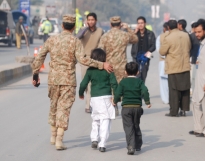
Pakistan woke up to a day of mourning on Wednesday after Taliban militants killed 132 students at a school in the city of Peshawar in a grisly attack which shocked the nation and put pressure on the government to do more to tackle the insurgency.
People around the country lit candles and staged overnight vigils as parents prepared to bury their children during mass funerals in and around Peshawar – a big, volatile city on the edge of Pakistan's lawless tribal belt.
Pakistanis may be used to almost daily militant attacks against the security forces but an outright assault on children stunned the country, prompting commentators to call for a tough military response.
In Peshawar, the vast grounds of the military-run Army Public School were all but deserted, with a handful of snipers manning the roofs of its pink brick-and-stone buildings.
Army vehicles and soldiers wearing face masks and carrying automatic rifles were deployed by the entrance.
A day after the attack, Peshawar appeared subdued and many were still in shock, recalling the gruesome events and trying to soothe each other. More details of the well-organised attack emerged as witnesses came forward with their stories.
"The attackers came around 10:30 am on a pick-up van," said Issam Uddin, a 25-year-old school bus driver.
"They drove it around the back of the school and set it on fire to block the way. Then they went to Gate 1 and killed a soldier, a gatekeeper and a gardener. Firing began and the first suicide attack took place."
The government of Prime Minister Nawaz Sharif has announced a three-day mourning period but people's anxiety focussed on what the authorities can do to protect the country.
Sharif came to power last year promising to negotiate peace with the Pakistani Taliban - but those efforts failed this year, weakening his position and prompting the army to launch an air-and-ground operation against insurgents along the Afghan border.
The military staged more air strikes against Taliban positions there late on Tuesday, a security source said, but it was unclear whether it was done in response to the school attack.
GOOD AND BAD TALIBAN
Yet, despite the well-publicised crackdown, the military has long been accused of being too lenient towards Islamist militants who critics say are used to carry out the army's bidding in places like the disputed Kashmir region and Afghanistan.
The military denies the accusations.
"People will have to stop equivocating and come together in the face of national tragedy," said Sherry Rehman, a former ambassador to the United States and an opposition politician.
"There have been national leaders who been apologetic about the Taliban, who have not named the Taliban in their speeches."
The Pakistani Taliban, who are fighting to impose strict Islamic rule in Pakistan, are holed up in the inaccessible mountains straddling the Pakistan-Afghanistan border.
They are allied with the Afghan Taliban as well as al Qaeda and other foreign fighters, and Pakistan has long accused Afghanistan of not doing enough to crack down on their bases.
Afghanistan, for its part, blames Pakistan for allowing militant groups such as the Afghan Taliban and Haqqani network to operate freely on its territory and stage attacks in Afghanistan.
Pakistan's army chief was expected to visit Afghanistan on Wednesday for what is likely to be a day of uneasy talks with his Afghan counterparts on how to tackle the insurgency.
Pakistan's Dawn newspaper quoted a source as saying that the militants were acting on direct orders from their handlers in Afghanistan and that prominent Taliban commander Umar Naray was the ultimate mastermind of the attack.
Speaking late on Tuesday, army spokesman Major General Asim Saleem Bajwa hinted at that without naming Afghanistan.
"When these militants reached the school ... we found out which group was involved, who they were talking to, from where the operation was being controlled," he said. "God willing, in coming two-four days you will get to know."