Christian leaders in sub-Saharan Africa have called for the increased prioritisation of healthcare in the region, particularly following the ending of US support.
Earlier this year US President Donald Trump introduced significant cuts to the USAID budget, with critics of USAID questioning the suitability of some of the items being funded by US citizens.
A transgender opera in Colombia, dance classes in China, and an Iraqi version of Sesame Street have all been cited by critics as evidence of the waste or misuse of taxpayer money.
Also affected is the President's Emergency Plan for AIDS Relief, funding for which was halted, pending a review.
In Nairobi leaders from 10 African countries and multiple Christian denominations met to explore alternatives.
The faith leaders issued a call to African governments and politicians to take responsibility for their own people by prioritising suitable investment in healthcare systems that can benefit all who need them.
Rev Francis Mkandawire, general secretary of the Evangelical Association of Malawi, reading out a joint statement by delegates, said, “We urge governments to sustain the frontlines of care and work with all sectors, including faith communities, so that no family is left without essential services. This includes faith-based partnerships.”
The statement said that caring for the sick and advocating for justice were fundamental expressions of Christian charity.
Joyce Khayiyi, a youth from the Anglican Church of Uganda, warned that cuts to assistance had left health systems across Africa vulnerable.
“Access to services and commodities among those most in need is reduced. As a result, lives are being threatened and lost,” she said.
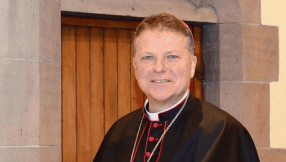
Bishop Matthew Kukah, Catholic bishop of Sokoto Diocese in Nigeria, called upon Christian leaders to "speak courageously about health from the pulpit and public life", saying that they were in the position to lend "moral authority" to the issue.
He went on to say that church leaders must also be much more proactive in holding national governments to account on their promises.
“I don't think the churches were there when the politicians committed themselves to 15% of their GDP that was supposed to be committed to help. So I think going forward, we also need to pay attention,” he said, referring to the 2001 African Union agreement in which governments agreed to commit 15 per cent of their GDP to the health sector.
The meeting was organised by the US-based Christian Connections for International Health, the All Africa Conference of Churches, and the Africa Christian Health Associations Platforms.
Dr Nkatha Njeru, Africa Christian Health Associations Platforms, said now was the time to strengthen collaboration with national and local governments. She is optimistic about the role that Christian organisations can play.
“In the face of funding reductions, we are seeing new partnerships and innovations, among the Christian health actors,” she said.