If you hang around in a railway station or an airport, you might browse through the bookshop. You'll often find a section headed "motivational" or "self-help". They'll have titles like How to Fulfil your Dreams and Reach your Destiny, The Seven Habits of Highly Effective People, Think and Grow Rich, and of course that old favourite, How to Win Friends and Influence People.
Turn to Ecclesiastes and it's a different story. The Preacher says: money won't bring you happiness. I read philosophy and didn't learn anything worth knowing. And by the way, we're all going to die.
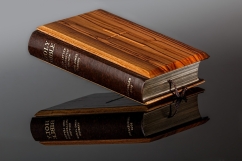
Imagine: between The Success Principle and The Purpose-Driven Life you have that runaway best-seller, We're all Doomed – otherwise known as Ecclesiastes.
This book runs against the current of a lot of thinking about how to live in this world. It isn't really negative at all. But it does say, be content. Go with the grain of life. Live in the light of eternity; live knowing that what's worthwhile isn't dictated by other people, or by passing fashions. You don't need to be rich or famous. Live knowing that you're under the eyes of God.
Chapter 3 starts, "For everything there is a time." It has the look of something that doesn't quite belong there; it may be a poem he's quoting. The Preacher tells us: discern the right time to do the right thing.
He tells us three things. First: we are spiritual people. Verse 11 says: "He has made everything beautiful in its time. He has also set eternity in the human heart; yet no one can fathom what God has done from beginning to end."
Generally speaking, in this country fewer people go to church than they used to. But everyone has a sense of beauty. Everyone has a sense that there's something bigger than themselves. Why is it that we respond to a beautiful painting or photograph? Why is it that we're moved by a piece of music – just an arrangement of sounds at different frequencies and amplitudes that can even move us to tears?
In every sort of human activity – art, sport or whatever – there's something that responds to truth, beauty and passion. That's an instinct that's been given to us by God. No one is beyond his reach, because there's something in all of us that responds to him.
Second, this: we are material people. We have worries about our bodies, how well they're holding up to the stress and strain of life. We have desires for things, and we need money to buy them. But what is actually worth having? So the Preacher says: "I know that there is nothing better for people than to be happy and to do good while they live. That each of them may eat and drink, and find satisfaction in all their toil – this is the gift of God."
He's saying, be content. Take satisfaction in your work, because it's a gift from God. You don't do it in order to be rich, successful or famous; you do it because it's worth doing in itself.
This isn't an argument for just putting up with work that makes us utterly wretched. But what the Preacher seems to be saying is that the priority is doing well what lies to hand; rewards are secondary. Rich people are sometimes defined in terms of how much they're "worth" – so and so is "worth" £100 million, perhaps. But that isn't what they're worth. They're worth what their character, heart makes them worth.
Third, we are responsible people. Verse 16 says: "I saw something else under the sun: in the place of judgment – wickedness was there. In the place of justice – wickedness was there." Goes on, "God will bring to judgment both the righteous and the wicked. There will be a time for every activity, a time for every deed." We have a sense of right and wrong, and we care about justice. And God will bring to judgment both the righteous and the wicked. We don't get to make up our own morality: we live in the light of judgment. Thank God, we live in the light of grace and mercy too, but right and wrong matter. We're called to choose: "There is a time for everything, and a season for every activity under heaven."
The chapter ends bleakly. "Man's fate is like that of the animals. The same fate awaits them both. As one dies, so dies the other." It's saying, "You don't know what happens next." At one level that's right; we can't prove there's a life after death. But we believe and trust there is – and before then, God calls us to live full, satisfying lives which are spiritual, material and responsible.
Follow Mark Woods on Twitter: @RevMarkWoods