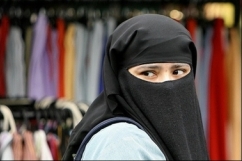
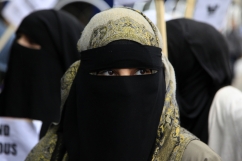
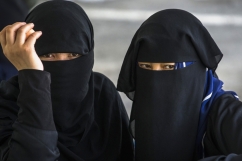
Should Britain ban the burqa? Are we really still asking that question?
Most people probably aren't, but for UKIP leadership candidate Lisa Duffy it's still a live issue. She wants full-face veils – presumably including the niqab that leaves the eyes visible – banned in shopping centres, public buildings and on public transport. According to the BBC, she said in a speech in central London that it's "a symbol of aggressive separatism that can only foster extremism". She added: "The veil speaks only to culture and oppression, not Islam, and there's no reason why we in Britain should allow it to be worn anywhere and everywhere."
Well, yes, actually there are lots of reasons. This is Britain. We don't tell people what to wear. We might not like someone's views, but they are free to express them. We believe in religious tolerance, and Christians believe that's indivisible – go for the Muslims and who knows who's next? And yes, maybe some women are forced to cover their faces, but most choose it as a sign of religious devotion. Meddle with that and you really have crossed a line.
These arguments are old ones, and they're tried and true. There will be no burqa ban in Britain, and there shouldn't be. To argue for it is dog-whistle politics of the worst kind. We all know the sort of person who'll agree with her.
But there's another reason to reject a ban. In taking this line Duffy is echoing, ironically enough, other European countries including Italy and Belgium, which have similar bans. France introduced a burqa ban in 2010. While it is still popular, it has been savaged by critics who have researched its result. According to sociologist Agnes de Féo, the ban has not only encouraged Islamophobia, but given Muslim extremists more of an excuse to rise up against the French state. "We created a monster," she told The Local. "Those who have left to go and fight in Syria say that this law is one of things that encouraged them. They saw it as a law against Islam. It had the effect of sending a message that Islam was not welcome in France."
Now, she pointed out, French people "live in a society where people think it's normal to insult Muslim women wearing the full veil just because they are disobeying the law".
The result of the ban is that younger Muslims have become more radicalised. Their religious identity has been scorned. They know they aren't truly accepted as French. They are outsiders, and they react as outsiders will. And while nothing can excuse the terrorist assaults France has suffered, the sense of alienation created by its aggressive secularism and refusal to countenance genuine religious integration has to be part of the explanation for it.
There are two things that proponents of a ban don't understand.
First: you don't make people less likely to be radical extremists by controlling how they express their faith. You make it more likely.
Second: You can't control people's beliefs, religious or otherwise. Freedom means allowing people the maximum possible latitude to hold whatever opinions they like – whether you like them or not. Insisting they conform to an invented norm isn't democracy, it's tyranny.
Third: beneath those burqas and niqabs there are real people who have minds of their own and a right to an opinion. They are not proxies for what you hate and fear, they are individuals. Treat them with respect. You might be surprised at the result.
There are serious questions about how some Muslims integrate into British society. Community cohesion is an issue, particularly in some of our towns and cities. No one's views should be unchallenged just because they're religious. But banning burqas? It's a non-solution, and probably even worse than that.
Follow Mark Woods on Twitter: @RevMarkWoods