I know that I was meant to love The Shape of Water. Guillermo Del Toro's Oscar-nom-dominating fantasy ticks every box for movie fans, and the awards recognition and rapturous audience feedback are no coincidence. In lots of ways it's a really wonderful movie, but for a warm-hearted romance it left me feeling strangely tepid afterwards.
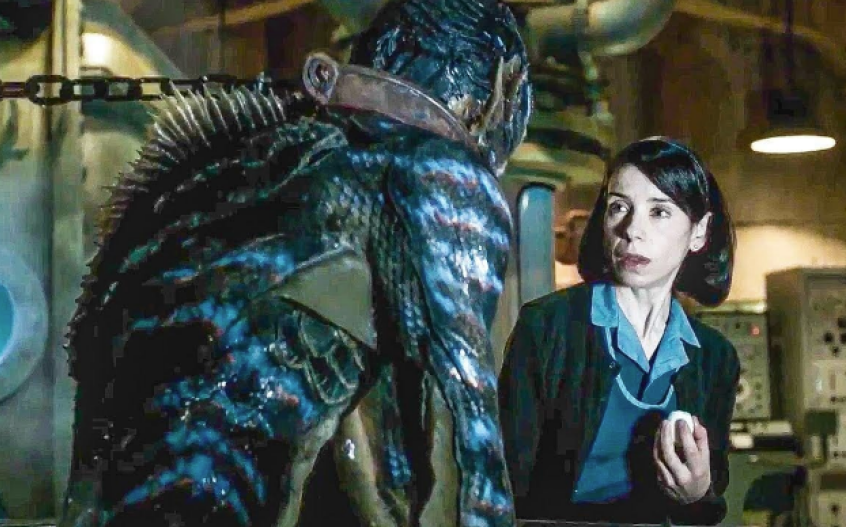
The individual praise heaped on some of the film's components parts is well warranted. Sally Hawkins is terrific in an almost entirely non-speaking role as Elisa, the cleaner at a strange military storage facility who develops an obsession with an aquatic creature which becomes imprisoned there. Michael Shannon is equally good as Strickland, the bleakly unpleasant military agent tasked with torturing and trying to understand the monster, and who proves to be far more monstrous himself.
Del Toro's vision is as always spectacular; his eye for the quirky and quietly profound second to none, acknowledged by his Best Director award at last night's Baftas. The score is beautiful. The script is note-perfect. I would not be at all surprised if the film makes a great return on its 13 Academy Award nominations.
Somehow though, the sum of these extraordinary parts don't add up to something more. The story, of Elisa falling in love with the creature (Doug Jones) and trying to break him out of the facility (and the clutches of the murderous Strickland), should feel uplifting but, to me at least, doesn't. I realise I'm running contrary to most of the other reviews of the film when I say all this, so let me try to explain why.
Elisa is a mute who lives alone above a struggling movie theatre. Her only friends are neighbour Giles, a wimpish older gay man, and fellow cleaner Zelda (Octavia Spencer – who's the subject of a sly Shack reference in one scene). Elisa's life is small and sad with few (slightly explicit) pleasures; each day runs like clockwork, and her life is dreary and grey until the creature arrives. Her encounter, and then developing relationship with the creature lead to greater and greater levels of escapism. Eventually, the film tips into fantasy, and it's as if the only hope for Elisa is to leave the life she knows forever, rather than somehow see it improve.
From a theological perspective, that's a bit like seeing hope purely in the afterlife. Heaven used to be pitched as 'pie in the sky when you die': an eternal reward after earthly suffering. Now, thanks to theologians like NT Wright, we've begun to realise that heaven is something that comes to earth; that the Kingdom of God advances and changes the here and now for the better. The gospel isn't just about getting through life so that you can enjoy your death – it's about redeeming the present too.
That note of redemption is what feels missing from Elisa's story. It's as if she's so much of an outcast, she can't find a way back in to real life. So instead of salvation we get escape. Instead of hope, we get fantasy.
Don't get me wrong: there's lots about The Shape of Water that I enjoyed, admired and even loved. Hawkins is absolutely brilliant in the lead role; for me even better than Frances McDormand in Three Billboards..., and it's a beautifully-constructed tale. It just didn't move me like it appears to have moved so many others. I don't just want hope for someone like Elisa in the arms of a weird mer-man thing, I want redemption for her in reality.
Martin Saunders is a Contributing Editor for Christian Today and the Deputy CEO of Youthscape. Follow him on Twitter @martinsaunders.