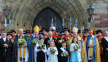
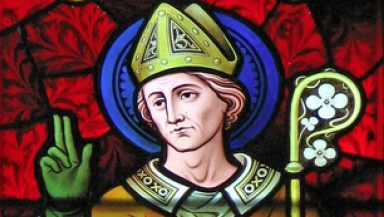
St Birinus (600-650 ish) is not really in the front rank of saints, in terms of recognition, though he is commemorated today in the Church of England. There are just a handful of churches dedicated to him and there is a St Birinus School in Didcot. He was the first Bishop of Dorchester. Apart from that, hardly anyone has heard of him.
He was, in fact, an important figure in early English Christianity. He came from what's now Germany to Wessex in 634 and attached himself to the court of the pagan West Saxon King Cynegils. Cynegils was trying to form an alliance with the Christian Oswald of Northumbria, who wouldn't ally himself with a pagan, and Bishop Birinus persuaded Cynegils it was worth converting.

So far, so Dark Ages. But aside from his evangelism and political savvy, it's worth remembering Birinus for a description of him by the Venerable Bede (672-735). Bede said he was 'a good and just man, who in carrying out his duties was guided rather by an inborn love of virtue than by what he had read in books'.
There would not, in fact, have been too many books around in Birinus' day, and those there were would have been lovingly hand-copied by monks. But their rarity and monetary preciousness added to their spiritual value: in every sense, the words they contained were worth reading. The ability to read – and access to books – conveyed prestige on those who had it. They were wise by association with the written word.
Birinus, though, according to Bede, was guided by 'an inborn love of virtue'. This is one of those times we wish the Dark Ages were a little lighter. What sort of person was he? Why does Bede – one of the great scholars of his age – make a point of distancing him from the sort of wisdom found in those lovingly illustrated vellum pages? And does that sentence speak to us today?
If Birinus' age was media-poor, ours is media-saturated. We are bombarded with text and images from the moment we wake – one study says four out of five smartphone users check their phones within 15 minutes of waking up in the morning. In Japan, 95 per cent of mobile devices are waterproof, so they can be used in the shower. Facts, factoids, opinions, news, fake news – it's all in our heads for hours every day.
The result is that words – written words, words spoken on news broadcasts and YouTube posts – are cheap. But what they lack in quality they make up in quantity. And we go to our favoured sources – our social media feeds, our preferred news sites – not to be educated, challenged or informed, but primarily to be affirmed. We want to be told that what we think is right, and that what we are is OK.
It's safe to say that Birinus, were he alive today, would have some serious questions to ask us. What about that 'inborn love of virtue' that guided him – and where, if not to Twitter or Instagram, should we go to find it?
I doubt, actually, whether Birinus' virtue was all self-generated. We all need to learn to be good. We learn it from other people – real ones, not pixels or posts – as we share their lives and they ours. We learn it from Scripture, as we dwell patiently on the best words ever written. We learn it through prayer, being still, stepping out of ourselves and being attentive to God. We learn it through the joyful, infuriating, maddening, heartbreaking, satisfying enterprise that is church.
The storm of white noise that is media today is probably not very conducive to spiritual excellence. Birinus might just be a saint for our times.
Follow Mark Woods on Twitter: @RevMarkWoods