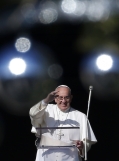
Mother Teresa will become a saint on September 4, Pope Francis has announced. This will conclude a process which began shortly after her death in 1997 yet it is remarkably quick for the Catholic Church.
After the ceremony, the Albanian born nun will become Saint Teresa of Calcutta and will be prayed to by devotees.
It sounds like fun. How do I apply?
It doesn't work like that, and it's not fun at all. For a start, you can't still be alive since it's only after you've died that the Church can be sure you aren't going to do something unsaintly. Also, lots of saints have also been martyred in pretty revolting ways – St Sebastian being shot full of arrows, for instance – and even the ones who died in their beds have often lived rather uncomfortably. Think Simon the Stylite, who spent 37 years living on a platform on top of a pillar.
So who does get to be a saint, then?
A saint is someone who has lived a life of extraordinary or heroic virtue. Catholics don't believe that they were sinless, just that they were special. Nowadays there are quite strict rules about who can be a saint, instituted by Pope John Paul II in 1982: a diocese decides on a likely candidate and an intensive survey of his or her life and works begins. The candidate passes through the stages of being recognised as a Servant of God, Venerable, Blessed and finally Saint.
Is there any flexibility?
Popes have quite a wide latitude in this respect. For instance, for non-martyrs to be sainted, two certified miracles have to have been performed through their intercession (we said the rules were strict).
I got a woodwork badge in Cubs. Is it like that?
It is considerably more rigorous, but if you mean that it is a recognition that someone has achieved something special, then yes. All Christians are saints, but many Churches teach that some are worthy of particular respect and can be reliably used as an example and inspiration to us.
Let me just play devil's advocate for a moment –
I'll stop you there. The Devil's Advocate was originally the person appointed to argue the case against sainthood for a candidate (officially the Promoter of the Faith), whose office was discontinued in the 1983 reforms.
Does that mean it's become easier to be a saint?
Arguably yes; the pace has picked up quite a bit. But the process is still quite strict, and some of the oddballs of previous generations would never make it now.
Oddballs? That seems a little disrespectful.
None intended, but in earlier days the process was a lot more informal. Local people would decide for themselves, or a figure from pagan legend would become Christianised and sainted, or a bishop would decide that a local saint was just what was needed to boost the tourist trade. The Vatican got increasingly edgy about this and by 1200 the practice was banned. In 1969 the Church took a hard look at its saints list and discovered that many of them might never have existed at all. One of these casualties was St Valentine, the patron saint of cheesy greetings cards.
Not really!
Well, no. But there plenty of other patron saints with rather odd responsibilities. St Clotilde is the patron saint of disappointed children, St Drogo is the patron saint of ugly people, St Bibiana is the patron saint of hangovers, and St Hubert of Liege – a rather niche interest, this – is the patron saint of the fear of werewolves.
How do saints get to patronise particular people?
It usually relates to an interest they had in their lifetimes. Hubert, for instance, werewolves aside, is the saint of hunters. He is said to have taught that hunters ought to only shoot when a humane quick kill is assured, that sick animals should be euthanised and that females with young should not be harmed. Others have more creative associations between their lives and saintly responsibilities: St Barbara, for instance, was tortured to death by her husband when she converted to Christianity. On the way home from her execution he was struck by lightning. She is the patron saint of gunpowder and fireworks.
But does the patron saint thing really make sense?
Yes, given certain assumptions. The Roman Catholic and Orthodox Churches have a much more developed idea of the Communion of Saints than do evangelical Protestants, who tend to assume that once a Christian dies they're in heaven and that's that. But there is nothing intrinsically odd about asking those who have deceased us to pray for us. James (5:13) says that the prayer of a righteous person is powerful, and saints are particularly righteous; and picking someone with a particular expertise in your field is arguably sensible.
Can't I just, you know, pray? To God?
Of course, but many would say that you can ask other people – living and even-more-living – to pray for you as well. Every little helps.
Out of interest, are there any Protestant saints?
The Church of England has one official saint, Charles I, whose dictatorial policies, untrustworthiness and treachery plunged Britain into a civil war that cost hundreds of thousands of lives.