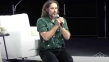
A PhD candidate with the Australian Catholic University's Institute for Religion and Critical Inquiry has been named the overall winner of ACU's Three Minute Thesis Final after adapting software originally used for genetic analysis to help scholars restore handwritten works to their original condition.
"My methodology can be applied to any written work subject to human errors, not just the New Testament," said Joey McCollum, a former software engineer.
"So much work relevant to the reconstruction of textual histories has already been done in evolutionary biology, and the textual criticism and digital humanities communities should be aware of how valuable it is to our work."
McCollum hopes that his new technology will show how biblical studies can have practical applications beyond purely theoretical areas of study such as exploring abstruse theological concepts.
"For a long time, biblical studies has had a reputation for being disconnected from other areas of study and distracted with impractical questions like how many angels can dance on the head of a pin," he said.
"In shaping my 3MT presentation, I wanted to show that biblical studies not only can have practical ramifications for things as important as the text of scripture and how we can read it more carefully, but also can have productive interactions with the sciences – even evolutionary biology – towards these ends."
Known as textual criticism, the discipline is devoted to restoring handwritten works to their earliest forms in the absence of the original manuscripts. It has been revolutionised by this new technology, with researchers now able to see how the original creators intended Scripture to be presented, offering deeper insight into the layers of meaning in the text and pictures that were lost in later editions.
The discoveries can influence how the modern printed editions and translations of works like the Bible look, shaping the scholarship, preservation, and exegesis (or interpretation) of the Bible. First used to help scholars analyse the available manuscript data for the New Testament book of Ephesians, the new technology will allow researchers to access previously hidden details contained in any of the manuscripts that have survived.
McCollum learnt New Testament Greek as a hobby and has already published five papers in several international academic journals. He expects to complete his PhD thesis next year.
His victory in the final has seen him progress to the Virtual Asia-Pacific 3MT Semi-Final Showcase, where he will vie to be one of eight finalists selected by the panellists to compete in the 2024 Virtual Asia-Pacific 3MT Final.
McCollum and the other finalists were congratulated by ACU Graduate School Research Director Michelle Lopez on the quality and significance of their presentations.
"The 2024 competition marks the 17th year of the 3MT, organized by the University of Queensland (UQ) and speaks to the continued popularity and evolution of the competition in fostering research communication skills and showcasing the exciting research of graduate research candidates," Lopez said.
"We were delighted to see a significant increase in participation in 2024 from our graduate research candidates. Our finalists from Law and Business, Theology and Philosophy and Health Sciences delivered engaging presentations, across a range of topics and the quality of the presentations were outstanding."
Mr McCollum said that he hoped that the success of his research would demonstrate that fields such as his own could offer something to the scientific disciplines that produced more tangible outcomes: "The humanities have little material promise in the spheres of human health, economy, and justice. But every day, every one of us navigates these spheres, and the humanities provide a means of grounding our experiences in history and giving our souls strength for the journey."