A feud between Australian Anglican leaders has boiled into the open with three bishops referred to an appeals court over a dispute surrounding the church's response to gay marriage.
The Archbishop of Sydney, the Bishop of Tasmania and the Bishop of Northwest Australia took part in a ceremony in June to consecrate rebel bishop Andy Lines offering 'alternative oversight' to conservatives disaffected by the perceived liberal drift of Anglican churches in Europe.
But fellow Australian bishops objected to their role, questioning whether it breached church law to appoint someone outside the official worldwide Anglican Communion.
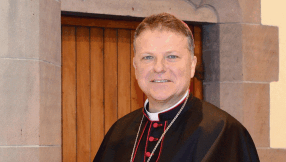
Now Australia's top bishop, Philip Freier, the Archbishop of Melbourne, has referred their complaints to the church's court of appeal who will offer a legal judgement.
Urging their boss to act, the Bishops of Bendigo, North Queensland, Gippsland and Willochra, say their conservative colleague's part in the ceremony 'raises fundamental questions of ecclesiology' and threatens to make relations between bishops 'gravely impaired'.
The church's Appellate Tribunal will now give a legal view on the fallout but cannot hand down direct punishment on disciplinary action.
The legal war between the bishops is likely to overshadow the church's synod, which will meet in just a few days time from 3-9 September. It comes as Australia is split by a vicious political debate on whether to allow gay marriage.
The Archbishop of Sydney, Glen Davies, the Bishop of Tasmania, Richard Condie, and the Bishop of Northwest Australia, Gary Nelson, were among the 11 primates, three archbishops, and 13 diocesan bishops from member churches of the Anglican Communion who participated in the ceremony in Wheaton College, Illinois, on June 30.
He was consecrated by the Anglican Church in North America (ACNA), a splinter body from the official Anglican church in the US – The Episcopal Church with other leaders from around the world taking part.
Davies, justifying his role, said he felt compelled to after the Scottish Episcopal Church, another member of the 80-million strong Anglican Communion, voted to allow gay marriage.
'As you will all know, I consider such an action to be a travesty of the rule of Christ, of the doctrine of the Book of Common Prayer, and therefore abandonment of the principles of Anglican doctrine,' he wrote.
'I consider that such a departure from the teaching of Scripture, 'the ultimate rule and standard of faith', casts doubt upon the nature of our communion with the Scottish Episcopal Church.'
Condie also wrote openly before the ceremony, apologising 'for any unintended hurt caused to our collegial relationships' but saying he had to act.
'The consecration is an emergency measure to protect the precious gospel of Jesus Christ, his authoritative word in the scriptures, and faithful Anglicans who have been marginalised by this schismatic behaviour... So-called 'cross-border interventions' by bishops into other dioceses are to be shunned in normal circumstances. However, when the gospel is at risk, these kinds of unusual measures are needed.'
It comes after Freier, their superior, urged his bishops not to take part.
'I take the view that communion – koinonia, is a gift of our Lord to his Church and that in our context it is the Anglican Church of Australia, through its constitution and the framework it establishes, that determines how this is expressed in practical terms,' he wrote.
He added it was not 'for us individually, acting independently, to determine with whom we are in communion or to act unilaterally to that end. I do not think that it is for individual dioceses in the Anglican Church of Australia to determine with whom we, as members of that Church, are in communion. We must act in accordance with the Constitution that binds us as the Anglican Church of Australia.'
Lines had his permission to officiate withdrawn by Southwark diocese after his consecration.