
The campaign by political blogger Paul Staines (Guido Fawkes) for the restoration of capital punishment has a strong Christian case behind it.
It is worth asking why Christian nations have historically enforced the death penalty whereas societies that are de-Christianising, such as Britain in the 1960s, tend to abolish it.
The answer lies in that society’s changing attitude to the authority of the Bible.
That is not to suggest that support for capital punishment is a cardinal doctrine of Holy Scripture. The Bible is centrally about eternal salvation through faith in Jesus Christ and the forgiveness of sins he died to bring all mankind, including those guilty of murder. But it is to argue that the Bible leans strongly towards the death penalty for murderers.
In Genesis 9, God establishes a binding agreement – ‘covenant’ - with Noah, in which famously the rainbow is the sign that God will not destroy the earth again by flooding. That covenant includes the following stipulation: ‘Whoso sheddeth man’s blood, by man shall his blood be shed: for in the image of God made he man’ (Genesis 9v6 – King James Version).
The fact that mankind, male and female, is created in the image of God has been established in Genesis chapter 1. The institution of the death penalty for murderers in the Noahic Covenant is thus a practical moral consequence of the fact that their victims are made in the image of God. They are guilty of murdering God's image-bearers and so their fellow men have the God-given responsibility to execute the death penalty upon them.
That does not mean that the image of God has been eradicated in the murderer; it means that his or her accountability to the God who has made them in his image involves punitive retribution by death.
That sound biblical theology is in fact reflected in the film The Book of Eli, set in post-apocalyptic America. The blind, Bible-carrying hero played by Denzel Washington kills in self-defence a henchman whom he had seen brutally murdering a husband and wife on the road. Having quoted in King James English God's condemnation upon fallen mankind in Genesis 3 - 'cursed is the ground for thy sake...thorns also and thistles shall it bring forth to thee' - Eli tells the man that he is accountable for what he has done.
That is not to support vigilante-ism but it is to say that the words put into the mouth of Mr Washington’s character are sound ‘image of God’ theology about the dignity of human accountability.
But isn’t the Genesis 9 mandate for capital punishment in the primitive Old Testament? The gory OT is set aside by the more humane New Testament, isn’t it? For example, Christians are not required to refrain from eating prawns, a clear prohibition for the people of God in the OT.
Yes, the NT does set aside the ritual and ceremonial laws of the Old. But the moral commands of the Old are not set aside by the New. Furthermore, the New affirms the Old's concept that fallen humanity still bears the image of God (see James 3v9).
Whilst the NT does not explicitly quote the Noahic demand for the death penalty, I would argue that its affirmation of the OT idea that men and women are God's image-bearers even in our fallen state means that capital punishment remains a moral requirement on the State. The death penalty is thus for AD as well as for BC.
The doctrinal basis of the Church of England in its 39 Articles of Religion supports the State's moral prerogative to exercise the death penalty and declares that Christians should not expect to be exempted from it. Article 37 - Of the Civil Magistrates - states: 'The Laws of the Realm may punish Christian men with death, for heinous and grievous offences.'
For me the NT clincher for the death penalty is the passage in the Apostle Paul's epistle to the Romans in which he commands Christians to respect the ‘powers that be’, describing them in this remarkable personalised way: ‘For he is the minister of God to thee for good. But if thou do that which is evil, be afraid; for he beareth not the sword in vain: for he is the minister of God, a revenger to execute wrath upon him that doeth evil’ (Romans 13v4).
The sword was an instrument of execution upon Roman citizens, of which Paul himself was one. We can thus see from his invocation of the sword of justice here that Paul clearly believed that the Roman imperial government, which he regarded as the 'minister of God', had a God-given responsibility to enforce the death penalty.
Julian Mann is vicar of the Parish Church of the Ascension, Oughtibridge, South Yorkshirei>




-

UN officials demand explanation for Iranian church seizure
-

AI could become a ‘very dangerous master’, warns John Lennox
-

Calls for Church of England to be 'rooted in scripture' ahead of General Synod elections
-

When Eastern Europe appeared to be going Protestant
-

Archbishop of Canterbury withdraws award given to Muslim cleric who praised Bin Laden
-

Most practising Christians are evangelical, study finds
Most Popular
News
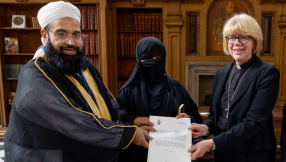
Archbishop of Canterbury withdraws award given to Muslim cleric who praised Bin Laden
Reform leader Nigel Farage said the decision to award Hafiz Muhammad Tahir Mehmood Ashrafi was "astonishing".

How the new General Synod could move beyond the present disagreement over same-sex relationships
How might the next Synod make progress in the next five years based on a recognition that there are those in the Church of England who hold fundamentally opposed positions on the matter? Is there a way of allowing both sides to achieve what they want? Martin Davie argues that the answer to this question is ‘Yes.’

No part of London should become a free speech, gospel exclusion zone
Soho is not exempt from freedom of speech and Christian expression. And Christians do not lose their fundamental freedoms when they cross an invisible boundary into a neighbourhood associated with a different worldview. The streets of London belong to all of us, writes Andrea Williams.
Church of England blessing same-sex relationships 'a bridge too far'
Earlier this year the Church silenced a group of former-homosexuals who wanted to tell of the change in their lives.








