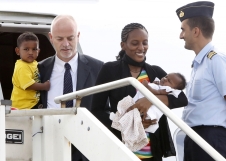
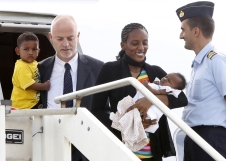
This week marks one year since Meriam Ibrahim was sentenced to 40 lashes for adultery, and death for apostasy. The campaign for her release was joined by thousands across the globe, including David Cameron, but although Ibrahim is now free, the situation for Sudan's religious minorities continues to worsen.
When the Court of Appeal declared Ibrahim innocent of all charges and released her from prison on 25 June 2014, there was cautious hope that the campaign would lead to wider respect for freedom of religion or belief in Sudan. But just five days after her acquittal, on 30 June, the Church of Christ in Thiba Al Hamyida, North Khartoum, was demolished after being given 24 hours' verbal notice.
As 2014 came to an end, religious minorities faced further restrictions. In particular, the Sudan Evangelical Presbyterian Church denomination (SEPC) has been embroiled in a legal battle to maintain ownership of its properties, which began with a court order to seize parts of the Khartoum Bahri Evangelical Church.
Over a three week period National Intelligence Security Service (NISS) agents entered the property en-masse, destroyed parts of the church sanctuary and bolted shut the clergymen's living quarters. The congregation began a peaceful sit-in protest against the forceful execution of the court order to confiscate property and five church leaders and 37 congregants were later arrested. The harassment and restrictions experienced by the SPEC are indicative of contracting freedom for religious minorities in Sudan; designed to reduce their influence as well as limit their economic base. Rev Yat Michael, a pastor who spoke at Khartoum Bahri Evangelical Church last December and encouraged the congregation to remain strong under pressure, was arrested by the NISS on the same day. Together with Rev Peter Reith, who was detained on 11 January, he faces very serious trumped-up criminal charges, two of which carry the death penalty or life imprisonment in the case of a guilty verdict.
On 19 May the two clergyman, who are both South Sudanese, will face a court hearing on six criminal charges. The application of such serious and unwarranted charges is of significant concern, particularly given the amount of time the men have been held in detention. At first they were held by the NISS without access to legal counsel or family visits, and at one stage the two ministers undertook a hunger strike in protest and to press for a court date.
The erosion of human rights in Sudan is not only restricted to freedom of religion or belief. The country's recent election, which saw the return of President Omar al Bashir, was marred by arbitrary arrests and enforced disappearances of opposition activists. Several opposition parties boycotted the vote entirely stating it would not be free or fair, which resulted in low voter turnout.
Meanwhile, the situation for Sudan's religious minorities is more precarious. Although some religious groups have continued to practice their faith with limited government interference, it's questionable how long this freedom will remain, especially as President Bashir returns with what he considers to be a mandate from the people.
A "national dialogue" has been established to bring together his ruling party and a selection of opposition parties to discuss issues of national interest and to draft a new constitution. The result of these ongoing discussions will indicate whether Sudan will move towards or further away from the protection and promotion of human rights for all.
Even though Sudan's current constitution guarantees freedom of religion or belief as defined by international law, Ibrahim's case highlighted the fact that these guarantees exist only on paper. To challenge this discrepancy, Ibrahim's lawyers have taken her case to the constitutional court; it now remains for the highest court in the land to uphold religious freedom as defined by the constitution.
Kiri Kankhwende is press officer for Christian Solidarity Worldwide. This article was written in collaboration with CSW's Sudan advocacy officers.