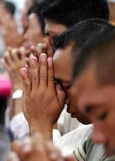
Shiite Muslim men and young boys beat themselves with sharp blades and chains and even cut their scalps with daggers on Saturday to commemorate the death of Husyn ibn Ali, the grandson of Prophet Muhammad.
The Muslim tradition, which dates back 1,300 years ago, is observed every 10th day of the Muslim month of Muharram [corresponding this year to Oct. 24], which is known as the Day of Ashura, also known as the "Day of Atonement," to remember the martyrdom of Iman Husyn, the son of Fatimah, Muhammad's daughter, who was beheaded during the Battle of Karbala in 680 A.D.
The violent rituals were performed by Muslim Shiites in Lebanon, Iraq, India, Pakistan and even in Athens, Greece "to represent their grief and as well wash away their sins," according to Christian News.
On Saturday, large crowds gathered in the streets of Iraq to observe the Islamic holiday, crying, beating their chests and cutting their heads until their faces and clothes were covered in blood, the AFP said.
Many Shiite worshippers reportedly traveled from neighbouring Iran and other countries to visit the [Karbala] shrine, which lies about 80 km southwest of Baghdad.
The flagellants have different ways of expressing their selves. Some older Muslims prefer to whip their backs with chains, while others use blades to draw more blood. For South Asian Shiites, they hold razors between their fingers while slapping their chests as other mourners hang weights from a body piercing, according to Reuters.
Despite the practice of the tradition in some Muslim countries, such form of expression is not sanctioned by mainstream Islamic authorities. Most prominent Shiite clerics have objected to all forms of self-mutilation because the expression has no basis in early religious history and appears barbaric to outsiders.
In 1994, Ayatollah Khamenei of Iran issued a fatwa against self-mutilation, and Ayatollah Ali al-Sistani, Iraq's most prominent cleric, also issued statements suggesting ambivalence about the practice, said the Explainer.
"But flagellation enthusiasts rejected the pronouncements entirely or claimed they prohibited only the cutting of the scalp with swords. Others accepted the fatwa and redirected their efforts toward more socially productive acts like Ashura blood drives. Over time, most clerics have muted their criticism as many Shiites' devotion to practice has been too strong to break.''
In other Muslim areas, however, the yearly tradition is reenacted in a less painful way. In Khorramabad, southern Iran, Shiites do the annual "mud rubbing" ceremony, while others burned down a tent during the reenactment of the Battle of Karbala.
Other reenactments include prolific weeping, wearing black, reciting mournful poetry, passion plays, sombre music concerts and fasting. In South Asia, it is traditional to build an ornate casket and carry it to the sea, said Reuters.