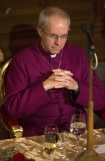
Clergy are now less trusted than ordinary people on the street, it has emerged, as a new survey reveals that what was once the most trusted profession has since plummeted in the public's eye.
Hairdressers are considered to be less likely to lie than clergy, along with doctors, teachers, judges, scientists and the police. The Veracity Index has been measuring public trust since 1983 and is carried out by pollster Ipsos MORI.
Now, only 67 per cent of people trust clergy to be truthful compared to 83 per cent 30 years ago.
Politicians remain the least trusted profession with only 21 per cent of the public saying they trust them. They are followed closely by estate agents and journalists, both on 25 per cent.
Bobby Duffy, director of the Social Research Institute at Ipsos MORI, said the public's lack of faith in politicians signified a "new crisis of trust".
"From this long-running survey we can see that public trust has been an issue for politicians for at least the past 33 years," he said.
"Other professions, though, have seen a long-term decline in trust, most notably the clergy, who were the most trusted profession when we started the series in 1983 and have fallen behind seven other groups."
The latest survey shows that people are more likely to trust each other than establishment figures, with 69 per cent trusting ordinary people on the street, compared to civil servants (59 per cent), lawyers (51 per cent), NHS managers (49 per cent) and charity chief executives (47 per cent).
Some commentators were especially surprised to see clergy falling below hairdressers in public trust. The Times suggested that "the salon chair has replaced the confessional", under the headline: "In God we used to trust, but now we prefer a hairdresser".
However, Christian Today spoke to one vicar who also works part-time as a hairdresser.
Reverend Ben Norton said he was not particularly surprised by the poll's findings.
"Sometimes clergy don't really connect with where people are at," he said. The Middlesbrough vicar explained people often feel clergy are different and distant and don't really relate to their lives.
Norton trained as a hairdresser before studying theology and entering the Church. However after moving to a new parish, he decided to put his old skills back to use to get to know his parishioners.
"For me hairdressing is a way to connect with people who don't come to church," he told Christian Today. "It is a really good way to get to know people and listen to people."
Norton does not wear his dog collar while cutting hair and people usually find out during their haircut that he is a vicar.
Most are surprised when they find out, Norton said, but they feel able to talk about faith because they've already had a normal conversation.