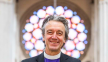
The Archbishop of Canterbury has said that same-sex marriage and issues surrounding human sexuality are things he wrestles with "every day, and often in the middle of the night".
Previous comments from Archbishop Justin Welby have led some to believe he is moving towards a position of support for same-sex marriage. However in this interview he insisted he was unwilling to precipitate the ongoing discussions.
"We don't make policy on the hoof, I'm not a pope," the Archbishop said in a live phone-in with LBC radio's James O'Brien.
"We've got to listen to people. We've got to speak to the Anglican community in other countries, and the LGBT community here. We've got to look at the scripture and the theological questions.
"We have to treat every human with equal dignity."
His approach, however, was not welcomed by all callers. Ann Widdecombe, the former MP for Maidstone and the Weald often noted for her staunchly conservative Christian principles, called into LBC and accused the Archbishop of a lack of clarity.
"The Church of England never seems to know what it thinks about anything," Ms Widdecombe claimed.
She expressed her frustration that discussion in the Church is less about what the Bible says and more often about what people want.
The debate in the 1990s on the ordination of women was for her the final straw that led to her leaving the Church of England, she said.
"The debate in Synod was not about 'is this theological', it was 'if we don't do this, we won't be popular in the modern world'. Yet still your pews are not full," she said.
"What I want is a church that says quite clearly what is and isn't right and wrong, regardless of whether it is popular."
Archbishop Welby's response was that he has been very clear on his position on sexuality on a number of occasions.
"Sexual relations should be within marriage and marriage is between a man and a woman," he said.
Explaining why he has been less than confrontational in relation to the issue, he said: "We say things with charity and respect with relation to the complexities of people's situations.
"People can't help being gay and we have to respect everybody's dignity."
He also argued that the Church's deliberations in one country could have huge ramifications for Anglicans in another.
"What we say here is heard around the world, and that has consequences," the Archbishop explained.
"I've stood by the graves a group of Christians in Africa who had been killed because of something that had happened a huge way around the world in America."
Archbishop Welby referenced one incident where pro-gay comments from Anglicans in one part of the world led to a violent and deadly attack against a church in Africa: "Their message was 'if we leave a Christian community here, we will all become homosexuals, we must kill the Christians'."
When asked by O'Brien if he was then saying that the reason the church was being so cautious was because of potentially violent reprisals, the Archbishop replied: "It's a terribly sad and tragic thing, but it is true, yes.
"I've spoken to church leaders in Africa, and they've said to me 'please don't change what you're doing because we couldn't accept your help if we do, and we desperately need your help'."
The Archbishop went on to say that the Anglican Church was very different to most people's perceptions. "The average Anglican is a sub Saharan African woman in her 30s," he said.
The phone-in was dominated by questions around sexuality, but other issues that were discussed included energy prices, food banks, the Church's history as a landlord, and promoting better understanding of the Church globally.
On energy prices, the Archbishop said: "In this country and in other colder climates, energy isn't something you have a choice about. It's an essential like water, you've got to have it and so how its priced is a moral issue."
He added: "There is no part of life that doesn't have a moral dimension."