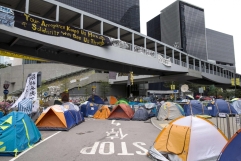
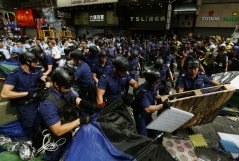
Thousands of pro-democracy activists forced the temporary closure of the Hong Kong government's headquarters on Monday after they clashed with police outside, defying orders to retreat after more than two months of sustained protests.
Chaos erupted as commuters made their way to work, with hundreds of protesters surrounding Admiralty Centre, which houses offices and retail outlets, in a tense stand-off with police. The central government offices and the legislature were forced to close in the morning, as were scores of shops.
The latest flare-up, during which police charged protesters with batons and pepper spray, marked an escalation in the civil disobedience movement. It also underscored the frustration of protesters at Beijing's refusal to budge on electoral reforms and grant greater democracy to the former British colony.
"The atmosphere in Admiralty is very different now after the clashes last night," said Jessica Lam, 20, who returned to the protest site on Monday morning. "It has become very tense, like back to the early days when the protest just started."
The democracy movement represents one of the biggest threats for China's Communist Party leadership since Beijing's bloody 1989 crackdown on pro-democracy student protests in and around Tiananmen Square.
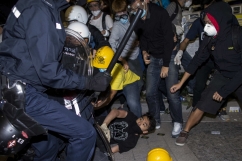
Hundreds of riot police scattered the crowds in several rounds of heated clashes overnight, forcing protesters back with pepper spray and batons as some tried to scramble over walls in a crush of bodies on a highway outside government headquarters.
Scores of volunteer medics attended to numerous injured, some who lay unconscious and others with blood streaming from head gashes. Police said at least 40 arrests were made.
Hong Kong Chief Executive Leung Chun-ying said police had been very tolerant but would now take "resolute action".
"Some people have mistaken the police's tolerance for weakness," he told reporters.
"I call for students who are planning to return to the occupation sites tonight not to do so," said Leung, who did not respond when if police would clear the sites on Monday night.
As police tackled the running battles in Admiralty, tensions escalated across the harbour in the gritty working-class district of Mong Kok, which had been the scene of violent clashes in recent weeks before the clearance of a large protest encampment from a major road there last Wednesday.
The unrest came as British lawmakers said they had been told by the Chinese Embassy they would not be allowed to enter Hong Kong as part of an inquiry into Britain's relations with its former colony and progress towards democracy.
The protesters are demanding free elections for the city's next leader in 2017 rather than the vote between pre-screened candidates that Beijing has said it would allow.
The overnight clashes came after student leaders called on activists to escalate their protests and surround government headquarters, galvanising supporters to make their way to the buildings in Admiralty, next to Hong Kong's central business district and some of the world's most expensive real estate.
Student representative Nathan Law urged protesters to continue the disobedience movement that began in late September, calling it a "long journey".
Despite several waves of clampdowns, crowds of protesters, many in protective goggles and body armour, refused to leave the area and continued to press against police lines, chanting "We want universal suffrage!". They threw bottles, helmets and umbrellas at police as tensions simmered into mid-morning.
Scores of demonstrators held up umbrellas, which have become a symbol of the pro-democracy movement, to protect themselves from the pepper spray and batons.
The latest clashes highlight the challenges authorities face as a restive younger generation contests Beijing's grip on the financial hub and demands greater democracy.
The Hong Kong rallies drew more than 100,000 on to the streets at their peak. Numbers have since dwindled and public support for the movement has waned.