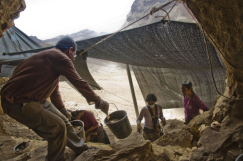
The first ever Philistine cemetery with 150 burials, dating back from 11th to 8th century BC, has been discovered after more than 30 years of excavating on the outskirts of the sea-port of Ashkelon in Israel.
A team of archaeologists said that the cemetery backs the theory that the Philistines landed in ancient Israel after crossing the Aegean Sea around the 12th century BC.
But much conventional wisdom, including the belief that the Philistines were a violent people, is overturned by the discovery according to the team.
The coastal city of Ashkelon, a few miles north of Gaza, is one of the five Philistine capitals along with Gaza, Ashdod, Ekron, and Gath. The cities are mentioned in the ancient texts of the Babylonians, Egyptians and Assyrians. In the Hebrew Bible, the Philistines were the nemeses of the Israelites and fought many great battles before being wiped out under King Nebuchadnezzar and his Babylonian army in 604 BC.
"Ninety-nine percent of the chapters and articles written about Philistine burial customs should be revised or ignored now that we have the first and only Philistine cemetery," said Lawrence Stager, Dorot Professor of the Archaeology of Israel, Emeritus, at Harvard University and part of the Leon Levy Expedition which made the discovery.
"The basic question we want to know is where this people are from," said Dr Sherry Fox, a physical anthropologist who is carrying out DNA, radiocarbon and biological distance studies on the bones.
"There is no evidence of any kind of trauma on the bones, from war on inter-personal violence," Fox told Haaretz.
Family or multiple burials are common in the region, with the deceased laid on raised platforms, but the dead in Ashkelon were found to be largely in individual oval pits. Second burials, common in the region, were not carried out. Artifacts found with the skeletons are indicative of Philistine culture, not Canaanite, the researchers said. They included storage jars, bowls and fine jewellery as well as arrowheads and spear points.
Fox added, according to the New York Times: "There's so much variation in how they are positioned, between whether they are cremated or buried; whether they are within a tomb, or a chamber, or a cist or a pit grave; whether they are placed face down or face up."
According to the Bible, the island of Crete – widely held to be Caphtor in Jeremiah 47:4 and Amos 9:7 – was the place from which the Philistines migrated to the Canaan coast.
"The search [for a cemetery] became so desperate that archaeologists who study the Philistines began to joke that they were buried at sea like the Vikings – that's why you couldn't find them," said Assaf Yasur-Landau, an archaeologist at Haifa University.
The "uncircumcised" Philistines are among the most notorious villains of the Hebrew Bible. One of them was the notorious giant Goliath, defeated by the young future King David with a sling-shot in the books of Samuel.
The Leon Levy team has been excavating in Israel since 1985.